Know Your Agent: the next layer of compliance
If you ask most compliance teams who their customer is, they should be able to tell you instantly. Ask them who the agent transacting on behalf of their customer is — what model powers it, how it fails, what it’s authorized to do — and you will likely be met with silence.
Whether or not compliance teams are aware or prepared, autonomous actors are participating in the global economy today. Agents are buying concert tickets, executing stock trades, booking flights, and moving money on behalf of a human that may be thousands of miles away from the IP address placing the order.
The compliance frameworks built on top of today’s payment rails were written for a world where a human authorized every transaction, but the world is changing.
How will LLMs behave under pressure? What failures will surface as agentic commerce scales? Where does liability sit when the entity transacting isn't human? The honest answer is we don’t know, at least not fully. What we do have is a framework that’s worked for decades, and a starting point for how to extend it.
At Rain, our founding principle for scaling agentic commerce is simple: Know Your Agent is an extension of Know Your Customer. This isn’t theoretical; Rain is powering agentic commerce partners and use cases today, and our due diligence process is now based on this standard when onboarding partners that support agentic purchases for users.
What does the Know Your Agent process look like? Before we onboard an agentic program, we evaluate the LLM that’s powering it. We look at how that model tends to behave and where it fails. An Anthropic-powered agent does not act identically to an OpenAI-powered one, and the differences matter.
We also require the partner to explain the agentic use case and walk us through how the agents will actually operate — the number of cards needed, the typical spending pattern of the agent, and where we should expect activity to occur are all essential details. From there, we build an agent profile. This is a behavioral baseline of what we expect to see, so that when an agent deviates from it, unusual activity and fraud stand out.
Of course, the agent profile only matters if it stays anchored to a human. Agents are not onboarded as new, independent entities; they are extensions of the customer. Just like human actors, though, agents are not perfect. They have vulnerabilities, and they do act in ways that are somewhat independent.
Compliance and risk teams across the industry are going to have to reconcile with this, and it’s top of mind for us at Rain. "The agent did it" can't become a catch-all loophole for cardholders, and at the same time, the framework has to leave room for legitimate errors that aren't fraud.
One of the most challenging realities is that agentic commerce is, in many ways, fundamentally at odds with long-standing fraud controls. Rapid transaction patterns and purchases from many different IP addresses simultaneously are classic indicators of illicit activity. Both are also inherent to how agents operate.
We are adapting our transaction monitoring to be able to distinguish between sanctioned agent behavior and genuine fraud, and we layer in program-level controls to keep that distinction enforceable. This includes things like caps on active agent cards, on cards created per day, and on total agent spend per user. When something does slip though — and it will — the potential for loss is much higher, so our detection and reaction time needs to be immediate.
AI is changing how money moves, and compliance teams have to be willing to sit with the hard questions this reality presents. At Rain, we’re compelled by the technical innovation, and we’re leaning in to build the compliance infrastructure that has to come with it. We believe in our foundation, and we’re putting it to work.
Rain is now a Mastercard Principal Member
Stablecoins are no longer on the fringe of global payments. The next wave is consumer spending and everyday business payments, and the infrastructure supporting that wave needs to be trusted, scalable, and global.
Today, Rain is announcing our Mastercard Principal Membership. This means that Rain can now offer credit and prepaid cards on the Mastercard network, giving our partners greater flexibility, control, and choice as they scale their stablecoin-powered payment programs.
What this means for our partners
Partners building global card programs need infrastructure that can meet them where their users are, and where their business is going.
Rain's infrastructure stack was purpose-built for stablecoin card programs, not retrofitted from a fiat model, and allows programs to expand across geographies through a single integration rather than rebuilding market by market. Partners get to market faster, and scaling after launch is simpler.
Mastercard is accepted by hundreds of millions of merchants across more than 210 countries and territories. That reach will now be available to Rain partners.
Settlement modernized behind the scenes
Beyond card issuance, Rain and Mastercard will explore settling select program flows onchain using regulated stablecoins. This matters because settlement can be capital-intensive and create operational constraints.
Traditional fiat models rely on fixed banking cut-off times and require partners to pre-fund several days of spending volume in reserve at all times, tying up liquidity and reducing flexibility. Rain’s infrastructure already supports daily settlement with card networks including weekends and holidays, cutting that collateral requirement significantly. Onchain settlement, once implemented, would take that further, supporting more frequent, always-on settlement while improving capital flow and keeping the cardholder experience exactly as it should be.
From the cardholder’s perspective, nothing changes. Cards continue to deliver the familiar, secure, and globally accepted experience they’re expected to. Stablecoins do the work in the background – strengthening settlement and liquidity flows rather than altering the moment of payment itself.
Part of something bigger
This announcement builds on Rain's recent selection as a launch partner in the Mastercard Crypto Partner Program, which brings together innovators across the digital assets ecosystem to advance onchain payments. Through the program, and now as a Principal Member, Rain and Mastercard will collaborate to explore new integrations, co-develop payment capabilities, and expand real-world stablecoin use cases.
It also follows Rain's $250M Series C, which we raised to accelerate exactly this kind of work: network integrations, international expansion, and new products that make stablecoin payments work everywhere.
The bigger picture
Tokenized money is the next era of money. Stablecoins are moving from niche instrument to core infrastructure, and the world's largest payment networks are moving with them.
From day one, Rain has believed that tokenized money must be usable in everyday life. Becoming a Mastercard Principal Member is another step toward making that real.
If you're building a card program and want to explore what Rain’s dual-network membership means for your business, let's talk.

Putting digital assets to work: Lydian launches a Rain-powered card program
Historically, digital assets rarely move outside of crypto wallets. Lydian is changing that.
Backed by Tether and Cantor Fitzgerald, they've built infrastructure for merchants across nine countries to offer a "Pay with Crypto" checkout option, so customers can pay directly from their wallet and merchants settle instantly in local currency. Now, they're expanding that reach with a new offering.
The Lydian Card, powered by Rain, plugs stablecoins and other digital assets into Visa’s global network, making them spendable at more than 150 million merchants worldwide. For crypto holders, getting access to that network, without converting to fiat first, changes what digital assets can actually do.
Lydian cardholders fund their accounts with stablecoins or another supported asset, and can tap, swipe, and check out just like they would with any other payment card, all while using their digital asset balances.
Merchants do not have to change anything about their checkout flows; they can use the same point-of-sale systems and they receive payments in local currency. The stablecoin infrastructure works entirely behind the scenes.
Lydian users have the option to receive virtual and physical cards, and because it’s a Visa Platinum Card, it’s a premium experience. Cardholders have access to a broad suite of benefits, including built-in car rental insurance, purchase protection on eligible items, extended warranty coverage, and 24/7 Visa customer service.
"Mainstream adoption happens when the underlying technology becomes invisible. We built Lydian to make spending digital assets feel as familiar as tapping a card at your favorite local shop,” Carl Grimstad, CEO of Lydian, said. “The Lydian Card now gives anyone that owns a digital asset—and most specifically Tether holders—the ability to use their stablecoins anywhere Visa is accepted.”
“By combining Rain's world-class stablecoin infrastructure with the premium benefits of a Visa Platinum Card, our users can now put their assets to work without ever having to worry about the complexity of conversion or settlement behind the scenes," Grimstad added.
Rain handles the infrastructure that connects Lydian's users’ stablecoin-backed spending power to Visa's network, enabling frictionless transactions and daily onchain network settlement behind the scenes, including on weekends and holidays. For partners like Lydian, this means less idle capital tied up in reserve balances, and faster time to market.
“The best infrastructure disappears, and Lydian understood that from day one,” Farooq Malik, CEO & Co-founder of Rain, said. “Now their users can use digital assets exactly how they’d spend fiat currency.”
Rain is committed to building the infrastructure that makes digital assets work in the real world. The Lydian Card is what that looks like in practice.

Fiat vs. stablecoin cards: what the difference means for your business
Key takeaways
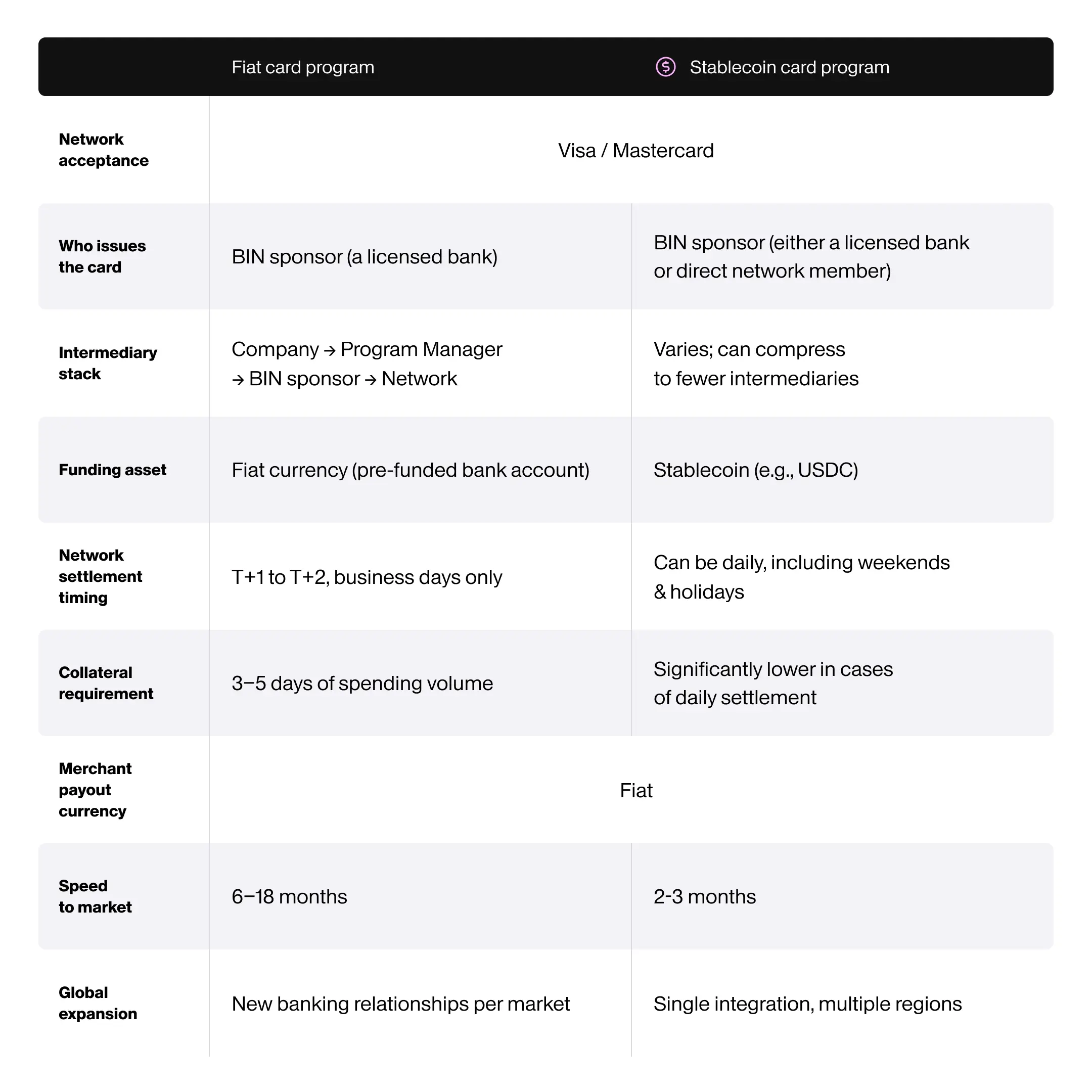
- Stablecoin card programs can go live in 2-3 months vs. 6-18 months for fiat programs
- Rain’s daily onchain settlement with card networks cuts partners’ collateral requirements significantly compared to the multi-day float required for fiat programs
- Rain-issued programs scale across geographies through a single integration, so partners are not required to rebuild in each market
- The benefits apply to any business looking to launch card programs, not just crypto-native companies
The default for businesses looking to launch a card program has long been the fiat-backed model, but that’s starting to change.
Stablecoin card programs are gaining traction, and not just from crypto-native companies. Fintechs, payroll providers, and global apps that once opted for traditional fiat setups are starting to consider an alternative model, and for good reason.
For cardholders and merchants, stablecoin-backed cards and fiat-backed cards are nearly identical. Transactions are seamless, acceptance is unchanged, and nothing about the payment flow feels new or unfamiliar.
The differences are structural, and they show up in the places that matter most to a business, like how much capital a program ties up, how long it takes to launch, and what it takes to expand internationally. The decision to go with a stablecoin or fiat model shapes the entire economics and footprint of a program from day one. Here’s how:
The stack: who's behind a card program
While fiat and stablecoin programs differ at the ledger and settlement layers, both are built on top of the same card network infrastructure. Let’s get to know these key components before explaining the differences:
- The card network: Payment networks, like Visa and Mastercard, set the rules. They maintain the acceptance infrastructure, facilitate settlement between card issuers and merchants, and authorize transactions. To issue cards that work on the network, companies need to be a licensed network member, which comes with capital requirements, compliance standards, and other ongoing obligations.
- The BIN sponsor/issuing bank: Every card has a Bank Identification Number (BIN), which is the first six to eight digits on the card. BINs are assigned to licensed entities that are network members.
- The program manager: Between your company and the BIN sponsor, there is often a program manager. This is a third-party team that handles technical integration, card management, branding, and day-to-day operations.
Key differences between stablecoin & fiat programs
Difference #1: settlement and reserve requirements
It makes sense to start with the settlement layer, because this is the biggest economic burden on a business.
In a traditional fiat card program, a company must maintain a pre-funded balance, known as an FBO (“for benefit of”) account, with their issuing bank. Settlement with the card network typically takes two business days. Because of that lag, the company has to keep three to five days of projected spending volume in reserve at all times.
Rain’s card programs operate on a different timeline, from both the fiat model and other stablecoin-powered models. Rain settles with the network in stablecoins every day, including weekends and holidays. Since funds move daily, partners don’t need to pre-fund several days of spending, and capital reserve requirements drop significantly.
Rain's integrated virtual accounts and onramps allow partners to fund programs in stablecoins or fiat currency, so businesses that want to benefit from the efficiencies that stablecoins provide without holding stablecoins themselves have the option. This setup is particularly helpful for companies that want to modernize their card infrastructure without changing how they manage their existing finances.
This is one of the most significant benefits of a stablecoin-backed model. If two card programs can produce a similar end-user experience, but one requires materially less idle capital to support settlement, the difference goes beyond a technical distinction and becomes an economic advantage.
Difference #2: program expansion and USD access
Issuing cards globally is one of the most strategic ways a business can expand its financial offerings, particularly when it comes to high-demand US dollar-denominated cards. But just as settlement infrastructure can be a barrier to entry, the expensive and complicated process of expanding internationally can be prohibitive for businesses.
In markets around the world, businesses and consumers actively seek access to dollar-denominated spending, but because most fiat programs are effectively limited to a US market, there are few options.
The reason is structural. Fiat programs are often built on local banking infrastructure, and many banks in international markets cannot support USD-denominated card programs. Foreign currency exchange regulations and limited access to the US dollar clearing system make running these programs expensive and challenging.
Even when international banks can offer a USD-denominated card program, there are unique underwriting timelines, capital requirements, and approval processes in different regions. Companies with international programs also need to maintain pre-funded FBO accounts in each country.
Stablecoin infrastructure can offer a different path. Because reserves can be held in dollar-backed stablecoins rather than relying entirely on local fiat banking infrastructure, a stablecoin-backed card program can be designed to scale across markets more efficiently. That does not remove compliance obligations or local considerations, and it should not be framed as though it does. What it can do is reduce some of the fragmentation that makes conventional fiat expansion so operationally heavy.
Rain holds network membership and operates across multiple regions through a single integration, so a program that launches in one market can extend to others without rebuilding from scratch.
For companies thinking about the addressable market, global demand for dollar cards isn’t a future opportunity. It exists today, and it’s largely underserved because the fiat infrastructure required to reach it is too fragmented and slow to build. Stablecoin card programs can streamline the process, giving businesses a faster path to expansion.
Difference #3: speed to market
Speed to market is another area where the difference between fiat and stablecoin programs becomes tangible.
With a fiat model, businesses are constrained by the fragmented timelines of their various partners. Even before implementation begins, businesses can spend two to three months on finding and contracting a program manager. Bank underwriting adds more time, and the issuing bank won’t advance the program until compliance infrastructure is in place and reviewed. When programs need to raise venture debt or enlist a credit facility to fund FBO accounts, the process is extended even further.
Stablecoin card programs compress this timeline because the infrastructure provider can absorb much of the stack. When the provider holds direct card network membership, like Rain, a separate BIN sponsor and program manager aren’t necessary.
Stablecoin programs have the same compliance requirements, but fewer interdependent partners means those processes can run in parallel rather than sequence. Instead of coordinating multiple institutions with separate timelines, companies can move forward through a single integration.
In card issuing, speed is leverage. The faster a program goes live, the faster it starts generating revenue, learning from users, and compounding growth.
What stays the same
For all of these differences, a lot of the core card experience stays the same, and that is an important part of the appeal. A stablecoin card is not a different category of financial product, it’s just built on different infrastructure.
Similarity #1: compliance requirements and risk mitigation
A stablecoin-backed card program is not a shortcut around the obligations that come with issuing financial products. Businesses are required to collect customer identification through Know Your Customer (KYC) and Know Your Business (KYB) procedures when onboarding new cardholders. Anti-Money Laundering (AML) monitoring and Suspicious Activity Report (SAR) filing requirements under the Bank Secrecy Act apply equally.
Stablecoin card programs carry the same fraud and financial crime risks as traditional fiat programs; card sharing, credential theft, and unauthorized use aren’t unique to either model. What’s required to manage those risks is also the same. Programs must screen customers at onboarding through a Customer Identification Program (CIP), verify beneficial ownership for business accounts, and apply sanctions screening against authoritative sources like OFAC and card network requirements. Ongoing transaction monitoring and fraud prevention efforts are essential elements of both programs.
Similarity #2: the card experience
One of the biggest strengths of stablecoin card programs is that they do not change the cardholder or merchant experience.
When someone uses a stablecoin card to buy groceries, pay for ads, or book a flight, the merchant is not being asked to accept stablecoins or adopt new payment infrastructure. At settlement, the merchant receives fiat through the normal network flow, with no changes to their existing process required. Likewise, the cardholder does not need to understand anything about the settlement mechanics in order to use the card; they just tap or swipe as normal.
Stablecoin card programs carry the same consumer protection obligations as fiat programs.
Picking the best program for your business
For a long time, fiat card programs have been the default choice, and in many cases that was simply because they were the established path. But established does not always mean optimal.
The stablecoin model not only gives businesses a new option for funding a card program, but also offers a totally different economic structure for launching and scaling the offering.
For companies thinking beyond a single market or expecting meaningful transaction volume, differences in reserve funding, timeline to launch, and expansion requirements add up. A reserve gap that looks manageable at low volume becomes a significant capital commitment as the program grows. A per-market launch process that seems acceptable for one geography becomes a serious constraint when the goal is five.
Finally, stablecoin card programs are not solely designed for crypto-native companies. The benefits of lower collateral requirements, faster launch times, and easier scaling are universal. With the right infrastructure provider, digital asset literacy is not a prerequisite for businesses or cardholders. If you’re ready to learn what a stablecoin-backed card program can unlock for your business, let’s talk.

Rain and Episode Six form long-term partnership, beginning with Asia-Pacific expansion
Episode Six's deep local infrastructure across Asia-Pacific and network integrations make it the foundational processing partner for Rain's regional expansion.
NEW YORK — April 1, 2026 — Rain, the enterprise-grade infrastructure for stablecoin-powered payments, today announced a strategic partnership with Episode Six, a leading global payment technology company and card issuer processor. Episode Six will serve as a key processing partner for Rain's credit, debit, and prepaid card programs across networks and geographies, with an initial focus on Asia-Pacific (APAC), where demand for stablecoin-powered payments is growing rapidly and Episode Six operates deep local infrastructure.
The announcement follows Rain's recent expansion of its Visa Membership into APAC and underscores Rain's commitment to building a best-in-class, globally distributed platform for enterprise card programs. With Episode Six, Rain's clients gain access to in-market solutions, Visa-certified processing, and a platform built to scale across the world's most active digital payments corridors.
"As we expand into Asia-Pacific and scale our programs across additional markets and networks, having processing infrastructure that can grow with us is essential," said Charles Yoo-Naut, CTO and Co-Founder of Rain. "Episode Six brings exactly what we need, with local presence in the markets that matter, proven execution at scale, and a platform flexible enough to support whatever we build next."
The partnership is timed to meet demand where it is growing fastest. APAC has emerged as the fastest-growing region for stablecoin payment volume, with cross-border B2B settlement and corporate treasury management among the most active use cases. For Rain's clients operating across the region, reliable local infrastructure is the difference between a program that scales and one that stalls. Episode Six's programmable money technology, including 10+ cloud instances across APAC and local deployments across the region's key high-growth markets, gives Rain's partners the regional depth and compliance readiness to move from program design to live deployment without rebuilding for every new market.
Episode Six's API-first platform also gives Rain full configurability over every program parameter, including fees, FX rules, risk thresholds, and spend controls, without the constraints of legacy processing systems. That flexibility is critical for clients who need to tailor card programs to their own business models and the regulatory requirements of each market they operate in.
“Rain is setting the standard for stablecoin-powered card programs globally, and we are proud to be the infrastructure partner powering that expansion in Asia-Pacific," said John Mitchell, CEO of Episode Six. "Our local infrastructure, scheme integrations, and purpose-built platform are designed for programs that need to operate at high volume, across borders, and in compliance with local requirements from day one. APAC is where we are starting, but the scope of what we are building with Rain extends well beyond this single region.”
Episode Six powers card and ledger programs across 50+ countries and is trusted by banks and fintechs worldwide to run multi-currency, cross-border programs across some of the world's most active payment corridors. For Rain, the partnership expands the range of processing choices available to enterprise partners building on its platform, ensuring that every program can be powered by infrastructure optimized for its specific region and use case.
This partnership reflects Rain's broader strategy of assembling the world's most capable and flexible stablecoin payments solutions. While APAC represents the first chapter, Rain and Episode Six are building toward a deeper integration across additional markets, networks, and program types. As that roadmap unfolds, Episode Six will play a central role in ensuring that every program Rain powers launches quickly, performs reliably, and reaches the users and markets it was built to serve.
About Rain
Rain is the global stablecoin payments platform for enterprises, neobanks, platforms, and developers. Its technology allows partners to move, store, and use stablecoins instantly and compliantly through global payment cards, rewards, on/offramps, wallets, and cross-border rails. Rain issues cards that work at over 150 million merchants across 150 countries. Built natively for stablecoins and trusted by more than 200 organizations worldwide, Rain delivers secure, scalable infrastructure that makes money move freely and instantly around the world. Learn more at https://www.rain.xyz/.
About Episode Six
Episode Six is a global provider of enterprise-grade card issuing and ledger infrastructure for financial technology companies, banks, and brands. Episode Six delivers the innovative capabilities needed to compete with disruptors and lead the market. Flexibility, adaptability, and resilience are built into the core of Episode Six's platform, ensuring clients maintain a market-leading position. Episode Six operates in over 50 countries, powering 70+ enterprise customers globally, with an expanding team located in the US, Canada, UK, Europe, Japan, Singapore, Hong Kong, Australia, and India. Investors include HSBC, Mastercard, SBI Investment Co Ltd, Anthos Capital, Avenir and Japan Airlines. For more information, visit www.EpisodeSix.com or LinkedIn.
Read original press release here: https://www.prnewswire.com/news-releases/rain-and-episode-six-form-long-term-partnership-beginning-with-asia-pacific-expansion-302730764.html
Media Contact:
Lucas Piazza
Marketing Lead, Rain
lucas@rain.xyz
Premium dollar cards for a borderless world
For high net worth individuals with global portfolios, the US dollar functions as the main currency for investments and capital movement.
Today, USD is used in nearly 90% of global foreign exchange transactions, making it an essential tool for globally mobile individuals. Even so, access to the financial tools built around the dollar remains surprisingly restricted.
In recent years, stablecoins — digital assets backed one-to-one by a fiat currency, typically the US dollar — have emerged as a new way to access dollars globally. But for high net worth individuals, access is only part of the equation. They need a way to spend.
Premium credit cards — the kind that unlock global spend, rewards, and luxury perks — typically require US residency, a Social Security number, and a domestic credit profile.
For those who split time across countries or primarily live outside the US, these requirements can be prohibitive. They may have US brokerage accounts, dollar-denominated investments, or onchain assets tied to the dollar, but when it comes time to spend, these individuals lack the right tools.
That’s where Rain comes in.
Dollar cards for global customers
Traditional premium card programs were designed for domestic banking systems. They assume the cardholder lives in one country, has a local credit file, and maintains a long-standing relationship with a domestic bank.
But wealth today is increasingly global. Many affluent individuals earn, invest, and transact across multiple markets, yet the financial products available to them remain tied to national banking systems.
International dollar cards offer a way to bridge that gap.
For fintech platforms, wealth managers, exchanges, and global financial brands, these programs create a new category of financial product: premium USD cards designed specifically for internationally mobile customers.
Many platforms already serve users who hold US assets or maintain dollar exposure. What they often lack is a compliant way to extend premium spending tools to those users.
With Rain, partners can launch branded card programs tailored to this audience — giving customers a way to spend globally while creating new revenue streams through card usage.
With a Rain-powered program, partners can offer:
- Dollar-denominated spending power: Cardholders can spend in USD-based assets while transacting globally, keeping finances aligned with their core assets.
- Premium card experiences: Rain’s card programs can be customized to include the perks and privileges expected from luxury financial products.
- Global acceptance: Rain-issued cards operate on major card networks, giving cardholders the flexibility to move across borders.
Built on stablecoin-powered infrastructure
Rain’s stablecoin-powered card programs connect digital dollars to global payment rails. Rain has secured the approvals needed to issue cards in dozens of countries, so partners can launch and scale programs quickly.
For users, Rain-issued cards work exactly as expected. Cardholders don’t need to hold crypto, and they won’t know stablecoins are powering everything on the back end.
Behind the scenes, Rain settles with global card networks every single day – including weekends and holidays – using stablecoins. For Rain partners, that means reduced working capital and reserve requirements, while still allowing programs to be funded in fiat via wire or ACH.
This architecture allows platforms to support globally distributed customers while maintaining the familiar experience of a traditional premium card. Cardholders simply use their card anywhere major card networks are accepted, while the infrastructure behind the scenes moves money more efficiently.
The next generation of premium card programs
As global wealth becomes more mobile, the financial tools people rely on need to evolve. International dollar cards give platforms a way to serve globally minded customers with premium USD spending experiences designed for how they actually live and transact: across borders, markets, and financial systems.
Rain provides the infrastructure that makes these programs possible, combining global card issuance with stablecoin-powered settlement behind the scenes. If you’re looking to launch a global USD card program for high-value customers, talk to the Rain team about building your international dollar card program.
Unlocking global access to US dollars
For many individuals and businesses, access to US dollars isn’t a luxury, it’s economically critical.
As the world’s primary reserve currency since 1944, the dollar underpins international trade, cross-border payments, and global capital markets. Today, USD is used in nearly 90% of global foreign exchange transactions and accounts for more than half of global reserves.
The dollar is the backbone of global commerce, yet access is still fragmented. In many markets, there are structural barriers, like limited availability of banking services, capital controls, currency volatility, and slow settlement times.
Stablecoins — digital assets that are backed one-to-one by a fiat currency, typically the US dollar — have emerged as a new tool for gaining exposure to USD. Unlike legacy systems that require banking relationships and intermediaries, stablecoins are borderless and settle instantly.
With stablecoins, overseas contractors can get paid in dollar-equivalents instantly and businesses around the world can hold working capital in USD as opposed to volatile local currencies. Families receiving remittances can avoid losing value to FX spreads and conversion fees when they use stablecoins.
Access is only one part of the equation, though. Holding stablecoins has its benefits, but being able to spend them anywhere is transformative for individuals and businesses. That’s where Rain comes in.
Digital dollars, built for the real world
By connecting stablecoins to global payment networks, Rain enables individuals and businesses to receive, hold, and spend USD value instantly, giving them new ways to access the global economy.
Rain’s platform powers the full flow of money, starting with onramps. Individuals and businesses can convert local currency into digital dollars quickly and compliantly, without navigating complex international banking flows. Rain supports both fiat and digital asset deposits, so users can fund accounts in local currencies via ACH or wire transfer, or with their existing stablecoin holdings.
Once an account is funded, value lives in secure wallets that function like modern digital dollar accounts. Users and businesses can send assets, manage treasuries, or hold value in dollar-equivalent currencies.
Rain-issued cards extend that functionality into the real world. With this payment layer, users can spend stablecoin balances anywhere Visa is accepted, connecting digital dollars to more than 150 million merchants globally.
Contractors can receive funds and immediately use them for daily expenses, minimizing production delays from delayed settlement and transfer. Businesses operating in high-inflation economies can hold value in dollars while still paying vendors locally, and remittance recipients don’t need to cash out when they need everyday essentials; they can spend directly from their balance.
When local currency is preferred, users can convert digital dollars back into fiat through Rain’s offramps. Funds move without the delays and excessive fees that often accompany traditional currency conversions or onchain-to-bank transfers. The result is a full financial loop: move value into dollars, hold stable value, spend globally, and exit seamlessly when needed.
Built natively for stablecoins
Millions of people around the world already hold stablecoins on exchanges and in self-custody wallets, but using these assets for daily purchases and expenses is challenging. The typical process requires moving assets between platforms, converting them into fiat, and waiting several business days before funds can be used.
Rain removes that friction by connecting stablecoin balances directly to global payment infrastructure.
As a Visa Principal Member, Rain issues cards that allow stablecoin-backed accounts to function within the same networks that power global commerce. Transactions work just like any other card payment from the merchant’s perspective, while stablecoin balances operate behind the scenes to power the experience.
The result is familiar for users and merchants while benefiting from the speed and reach of onchain infrastructure.
Digital dollars become immediately usable, not just stagnant value sitting in a wallet.
Expanding access to the global economy
Access to US dollars has historically depended on local banking systems and correspondent bank relationships that vary widely across markets. For many individuals and businesses, these systems create friction rather than opportunity.
Stablecoins introduce a different model. Anyone with internet access can hold and move dollar-denominated value without relying on traditional banking infrastructure. When those digital dollars connect to global payment cards, they become usable in everyday commerce.
Workers can receive international payments and spend them immediately. Businesses can manage treasury in stable currency while continuing to operate locally. Families sending money across borders can preserve more of what they transfer.
Rain brings these capabilities together through infrastructure designed for stablecoins and connected to global payment networks. The result is simple but powerful: digital dollars that are not only accessible, but usable anywhere people already spend.
If you’re ready to explore how stablecoins can power global access to dollars for your business, let’s talk.

How Rain reduces risk: a guide
Moving money is serious work.
Rain helps facilitate instant, global payments at scale. Our systems support real-world economic activity, and therefore must be designed to operate reliably in practice, not just in ideal conditions.
Tokenized money introduces new capabilities. It also introduces new responsibilities. Infrastructure companies, like Rain, have to do more than move value quickly. We have to build controls that keep that value from flowing in the wrong direction, and response plans for when risks are identified.
This guide describes Rain’s risk mitigation program. It explains how we reduce, identify, and respond to threats throughout the lifecycle of a payment program. It’s a practical look at how we think about responsibility, how we maintain compliance and regulatory standards, and why we operate with the assumption that risk needs constant attention.
Risk ownership and responsibility
Effective risk management depends on clear ownership. Rain structures its programs to ensure that responsibility for risk is explicitly defined across all parties involved.
In programs where Rain manages the payment stack directly, Rain is wholly responsible for transaction-level risk controls. Rain is also responsible for assessing Anti-Money Laundering (AML) and fraud risks and for collecting and verifying key identity elements in these programs.
In partner-managed programs, partners are able to add additional transaction risk protections specific to their product. Partners are responsible for assessing AML and fraud risks and for identity verification in partner-managed programs.
Fraud prevention is a shared responsibility. Rain works together with partners to detect and reduce fraud through multiple layers of monitoring and clear escalation paths. Fraud losses and liabilities are primarily the responsibility of merchants and partners, consistent with how card networks operate today.
Clear ownership keeps risk from pooling in the wrong places. When responsibility is unambiguous, responses are fast, coordination is efficient, and accountability is maintained.
Picking the right partners
Before any program goes live, Rain completes an extensive due diligence process to confirm that we’re choosing the right partners.
Every partner is required to complete a Know Your Business (KYB) review. That includes verifying company formation documents, identifying and validating beneficial owners, screening for sanctions, politically exposed persons, and adverse media, and reviewing the partner’s website and business model to understand how the program works.
When a program or partner carries additional risk, the threshold is higher. When indicated, Rain will implement additional requirements. These may include heightened AML requirements, independent audits, and ongoing reporting obligations.
This process is how Rain builds durable partnerships that support sustainable, long-term growth.
Customer due diligence
Every Rain program starts with a simple rule: If someone is going to spend money, we need to know who they are.
At minimum, partners are required to meet established customer due diligence requirements and Customer Identification Program (CIP) standards. This includes collecting a legal name, date of birth, address, and a government-issued ID number.
As an added step, Rain employs additional identity verification checks. This higher standard of collecting IDs sets a stronger foundation for knowing the customer and preventing fraud.
Knowing who cardholders are is only the first step in Rain’s KYC process. Understanding how an account is likely to be used is just as important for detecting misuse. Rain collects additional cardholder information, including occupation, annual income, and IP address. These details provide more context for what “normal” looks like, so if there is unusual activity, it stands out.
Before programs launch, Rain verifies that these KYC steps are embedded into the partner’s UX and onboarding flow. Programs do not go live until identity and context collection are actually enabled, not just described in documentation.
Geography and sanctions
Where an account is created, accessed, and used materially affects the risk profile of a payment program. As such, geographic and sanctions controls are a foundational component of Rain’s risk mitigation framework.
Rain applies controls to prevent signups from sanctioned or restricted jurisdictions and to block transactions involving merchants or counterparties in sanctioned or restricted regions. These controls are informed by authoritative sources like OFAC and by network requirements, including Visa’s rules.
Geography isn't stagnant — people move, devices change, and usage patterns shift — so controls are enforced at multiple points. This includes during onboarding to prevent account creation from sanctioned locations, through ongoing monitoring to identify changes in user behavior or location, and at the transaction level to screen activity in real time.
By applying sanction controls across these layers, Rain reduces reliance on any single checkpoint, ensuring compliance and risk mitigation remain active throughout the life of the program.
Fraud and FinCrime monitoring in practice
The above steps cover what happens before programs go live and cards are issued, but risk management doesn’t stop there.
Rain continuously monitors transactions to catch behavior that looks off, and measures are in place to block certain purchases at the authorization level. For example, transactions from sanctioned or restricted countries or certain high-risk merchant categories are declined. Rapid-fire transactions can be stopped when velocity limits are hit. ATM withdrawals have per-transaction and daily caps.
Rain also has an onchain screening program, which includes continuous monitoring of wallet addresses and blockchain activity for suspicious activity. Smart contracts are also reviewed by an outside auditor before they are deployed.
These rules are only a subset of Rain’s transaction monitoring controls. We apply additional rules and dynamic risk signals in real time to adapt to evolving threats and usage patterns.
The limits of risk mitigation
Stablecoins, by design, offer some real advantages when it comes to risk mitigation. Transactions settle on a shared, immutable ledger, so the history of where funds came from is traceable. Settlement is also atomic, meaning transactions either immediately complete or fail, eliminating timing gaps and reconciliation risks that exist in traditional payment systems.
Still, no payment system is perfect. Card sharing, credential theft, and secondary markets exist across all forms of card-based payments, including traditional fiat programs. These risks are not unique to stablecoins.
We acknowledge this reality explicitly because it’s a prerequisite to building durable safeguards. Pretending that misuse can be eliminated entirely doesn’t make systems safer, it makes them vulnerable. Rain focuses on early detection, fast response, and continuous improvement, not overconfident promises.
Rain’s systems are designed with the expectation that anomalies will happen. That might be attempted fraud, an operational error, a partner control failure, or a pattern of transactions that simply doesn’t make sense. That’s why Rain maintains layered monitoring and response controls.
When thresholds are triggered, alerts are reviewed under clear procedures. Rain’s response framework focuses on timely containment, investigation, and documentation. Accountability matters here. Responses are assigned to specific operational or compliance owners, and material issues move through established governance channels.
Rain isn’t built for clear skies only. It’s built to keep working when conditions change.
Transparency, with guardrails
Rain believes in transparency, but we do not disclose every risk control or threshold. Publishing this information would meaningfully help bad actors work around the system. As a payments provider, we also have a responsibility to protect sensitive information and respect confidentiality commitments to our partners.
Responsible transparency means being open about our approach to risk mitigation without compromising the systems themselves.
Our work isn’t done
Risk management is never finished. As products evolve, regulations change, and threats emerge, controls have to adapt. Rain treats risk management as a continuous responsibility, not a one-time exercise.
We’re building products that fundamentally disrupt how money moves around the world. Trust and safety can’t be an afterthought, they’re the foundation.

Expanding economic access through spendable digital dollars
With a total market capitalization of more than $300 billion, stablecoins have quickly become one of the most widely-held digital assets in the world.
US dollar-backed stablecoins are increasingly being used to move money across borders and preserve purchasing power, particularly in high-inflation economies. But as adoption scales, a core question remains: if someone sent you stablecoins, how would you spend them?
That’s why Rain started with cards. Our infrastructure connects stablecoins directly to global payment networks, making them spendable virtually everywhere. For individuals and businesses in high-inflation markets like Bolivia, this is transformative economic access.
Watch the full video to see how Rain works, and if you’re ready to launch a stablecoin payment solution, let’s talk.

Leveling up branded apps with payments
Over the past decade, brands ranging from sweetgreen and McDonalds to Nike and Ford have invested heavily in owned digital experiences by developing and launching branded apps. But most in-app interactions still represent a limited window of engagement. Users show up when they need something, then leave.
Take a sports team app, for example. Fans might download the app and open it on game day to check a player’s stats or the season’s schedule, and then they move on. User behavior is episodic.
Many brands try to solve this problem with an add-on rewards offering, but even these efforts still fall short of creating a habitual user experience. With a typical rewards layer, fans could earn points when they buy tickets or merchandise, which can then be redeemed for discounts on future purchases. The issue is these payments are made with third party, not co-branded, cards, so the team isn’t earning on interchange revenue, and the fan isn’t collecting rewards on the rest of their everyday spending.
Add in a payments component, though, and the app suddenly gains a lot more utility. For fans, this means a way to earn brand-specific perks, even on unrelated spending. For businesses, this means more revenue and higher retention.
Rain’s Branded Wallet-in-a-Box gives businesses everything they need to launch a robust payments program in the app their customers already use.
Turn intermittent engagement into everyday utility
When a brand offers a co-branded card and integrates it inside its own app, they can start creating spend-driven loyalty. This isn’t a points program bolted onto the side, but a financial layer that strengthens the relationship between the brand and the user with every transaction, on or off the platform.
Instead of engaging only in limited moments, like game day, a payments layer incentivizes users to engage more often.
Here’s what businesses get with Rain’s Branded Wallet-in-a-Box:
- A white-labled wallet embedded into an existing app or experience
- Onramps that allow users to fund accounts with both crypto and fiat currencies, including through cards and ACH
- Stablecoin-backed balances with conversion handled behind the scenes
- Programmable rewards tied to user spend or other activities
- Merchant and brand-funded rewards and sponsorship opportunities
- Rain-issued cards that can be used anywhere Visa is accepted
The result is a branded payments and loyalty experience that works on-platform, and in the real world, wherever your users spend.
Rewards with real attribution and ROI
Rewards are the layer that makes branded payments truly sticky. With Rain, rewards aren’t limited to purchases inside your own checkout flow.
With co-branded cards usable anywhere Visa is accepted, brands can utilize transaction data in real time. Rain helps you partner with third party businesses to create merchant-funded incentive programs, meaning users can earn where they’re already spending money — like their nearby grocery store, routine gas station, or favorite online retailer. Every redemption becomes an attributable event, and every campaign can be evaluated through transaction data, delivering measurable return on ad spend.

Why this works
Most loyalty programs are add-ons that live outside the core product experience. Points are tracked in a separate system, rewards are redeemed somewhere else, and the loop between spending and value is weak.
Closed-loop payments, like the bank-like system Starbucks uses, solve part of that problem, but introduce a new one. If value can only be spent inside a single ecosystem, usage is capped by how often a customer shops there.
Rain’s approach is different: embed the wallet and rewards inside the app, then extend spending via co-branded cards that work anywhere Visa is accepted. Businesses get full visibility into spend behavior and can earn interchange on every transaction, not just purchases made in their own checkout flow.
More efficiencies for businesses, same experience for users
Rain’s stablecoin-native rails make card programs more accessible for brands who otherwise would be priced out by traditional issuing economics. We settle with Visa every single day — including weekends and holidays — dramatically reducing working capital and reserve requirements for businesses.
Stablecoins make things cheaper and faster, but because Rain’s infrastructure keeps the complexity on the back end, partners and cardholders can reap the benefits without needing to touch crypto or change how they pay. Programs can be funded in fiat via wire, ACH, or SWIFT transfers, and for cardholders, swiping a Rain-issued card is the same familiar experience they know and expect.
Every Rain-issued card program includes required KYC and AML workflows. We cover onboarding, identity verification, ongoing monitoring, and country-specific requirements, so you can stay compliant without having to build your own risk and ops stack.
The next era of branded platforms
A payments layer takes branded apps to the next level.
The ability to store value, spend anywhere, and earn brand-native rewards transforms occasionally visited platforms into something users embed into their daily lives. For businesses, payments mean better retention and new revenue streams.
Rain’s Branded Wallet-in-a-Box helps you launch this experience quickly, without compromising on compliance, card usability, or global scale.
If you’re a brand looking to turn intermittent engagement into a daily habit loop, let’s talk.

Giving stablecoins real-world spending power
Stablecoins have quickly become one of the most widely-held digital assets in the world. In 2025, the total stablecoin market capitalization surpassed $300 billion.
So far, demand has mostly been driven by companies and consumers looking to settle cross-border invoices or send remittances. Cryptocurrency traders also use stablecoins as a way to access liquidity. In each case, stablecoins have proven their value as efficient settlement tools and digital dollar equivalents that move quickly across borders.
Thanks to the countless crypto exchanges and wallet providers available, it's easier than ever for businesses and consumers to buy, hold, and send stablecoins. But after the trade is made, or the invoice is settled, or the remittance is received, the recipient is left with a question: how can these stablecoins be used to make everyday purchases?
The answer is that it’s not easy. Turning a crypto wallet balance into value that real-world merchants accept can be an expensive, long process with multiple intermediaries along the way.
Easy to acquire, hard to spend
Consider a contractor who gets paid in USDC, one of the most popular stablecoins. It is an excellent currency for settling invoices because transfers are fast and inexpensive, even internationally. A business sends the contractor’s payment to their wallet, and now that value sits onchain, fully settled in seconds.
But when the contractor wants to use that USDC to buy their morning coffee or their ChatGPT subscription, the experience becomes more complicated.
In most cases, here is what they would need to do:
- Transfer the USDC to an exchange or conversion provider
- Convert to fiat
- Withdraw to a bank account and pay the related fees
- Wait a couple of business days for the funds to show up in the account
- Buy the coffee
Of course, waiting two business days to buy a $6 latte or pay for a critical digital subscription is impractical. Stablecoins move instantly onchain, but the moment you want to use them in the real world, you’re forced back into legacy banking rails.
The result is that stablecoins often remain savings balances or trading tools instead of becoming true everyday money.
Rain changes that.
Connect your stablecoins to Visa’s global network
Spending stablecoins is such a cumbersome process because historically, stablecoin rails and traditional payment networks have operated separately. Rain brings them together.
As a Visa Principal Member, Rain-issued cards can be used at over 150 million merchant locations in more than 150 countries.
With Rain-powered card programs, users link their onchain wallet, and we handle the rest. Cardholders can tap, swipe, or check out online just like they would with any other payment card, all while using their stablecoin balances.
Here’s how that same coffee purchase would work using a Rain-powered card:
- Fund the Rain account by linking a wallet
- Use the Rain-issued card at checkout
- Buy the coffee
For users unaccustomed with crypto platforms, Rain also supports fiat onramps. Accounts can be funded with ACH or wire transfers, no crypto knowledge required. In either case, though, the card experience remains familiar and seamless.
Built natively for stablecoins
Not all crypto card programs are designed to make stablecoins truly spendable.
Most crypto cards are actually just fiat cards with rewards paid out in crypto. Others operate like a debit card where crypto holdings are sold for fiat at the point of purchase, creating tax complications down the line. Rain’s programs are different because it’s a credit product, so merchant acceptance is higher and partners take home more on interchange.
For cardholders, this means being able to spend directly from their stablecoin holdings. For partners like exchanges or wallet providers, this means adding in a payments layer that keeps users engaged and on-platform, all while adding a revenue stream.
On the front end, you’d never know stablecoins were involved, but on the back end, things move more efficiently. Rain’s stablecoin-powered infrastructure enables real-time conversion and daily settlement with Visa, even on weekends and holidays, so partners can launch a card program without needing to hold massive reserve balances.
Turning stablecoins into everyday money
Stablecoins have proven their value as digital dollars for settlement and liquidity, but to get to a place of mainstream adoption, they need to be usable
When stablecoins can be spent anywhere Visa is accepted, they move beyond trading desks and treasury workflows and into daily life. They become real money.
If you are building a wallet, exchange, neobank, or financial platform and want to turn stablecoin balances into real-world purchasing power, Rain provides the infrastructure to do it. Let’s talk.

B2B stablecoin payments that settle in minutes and spend instantly
If you work with international suppliers, contractors, or vendors, you know the drill when it comes to settling invoices: send the payment, and wait.
It can take more than five business days for funds to move from payer to payee, slowing down production, straining supplier relationships, and tying up capital.
This isn’t a niche problem, and the stakes are only getting higher. Cross-border spending topped $194 trillion in 2024, and is projected to increase to $320 trillion by 2032.
The economy is changing, and our payment rails need to adapt. As supply chains, labor markets, and commerce become more global, consumers and businesses need infrastructure that will support operations and make payments efficient, cheap, and fast.
The future is programmable payments with instant settlement
Now picture this: a payment is automatically triggered, initiated, and settled in minutes. Suppliers are paid and production begins the same day. Built‑in payment logic and real‑time settlement come with big upsides for businesses:
- Working capital gets deployed instead of sitting in transit.
- Manual processes are cut out when payment logic is milestone‑based.
- Reconciliation is faster because the status is visible in real-time.
- Supplier relationships are stronger when payments arrive on time, every time.
Real‑time rails are no longer niche. There were 266.2 billion real‑time transactions in 2023, up 42.2% from 2022, a sign that instant movement of funds is becoming standard infrastructure.
What’s powering programmable payments? Stablecoins.
Stablecoins move across decentralized, always-on networks that settle in minutes without the friction of banking hours or cross-border intermediaries. That speed and availability unlock the power of programmable logic and instant confirmation, meaning payments move from initiation to completion in fewer steps.
There is a catch, though. Instant settlement doesn’t guarantee instant spend.
Instant settlement still isn’t instant spend
Stablecoin‑powered payments remove intermediaries and clear quickly, but they typically require both parties to hold and use crypto. If a supplier needs to off‑ramp to fiat before spending, you just cut one delay to create another.
This is where Rain’s card issuance comes in. With Rain, recipients don’t have to manually convert from stablecoins to fiat or wait on banking windows. Funds can be loaded onto a Rain‑issued card that operates over the Visa network, allowing suppliers to spend immediately at more than 150 million merchant locations worldwide. That means raw materials, freight, fuel, per diem, and incidentals can be paid right away—no separate off‑ramp step required.
When recipients can use funds instantly on the rails they already rely on, stablecoin‑powered B2B payments stop being a workflow change and start being a straightforward upgrade. This is where adoption happens, and it’s happening now.
Rain partnered with Nuvei to launch a comprehensive blockchain‑based payment solution for merchants across Latin America. The solution includes stablecoin payment rails for faster cross-border settlement and integrated Visa-accepted cards for merchants, making the stablecoins instantly usable.

What Rain brings to the table
Rain was built to power end‑to‑end, instant‑spend B2B flows. It comes in one package, no patchwork-assembly required. Core capabilities include:
- Fiat onramps via ACH, wire, or SWIFT with conversion to stablecoins and funding to an enterprise wallet.
- Wallet infrastructure to store, manage, and access stablecoins
- Programmable cross‑border transfers via API, with real‑time status and rich metadata for audit and reconciliation.
- Integrated compliance (KYC/AML) embedded in the flow.
- Immediate spendability through Rain‑issued physical and virtual cards that your recipients can use anywhere Visa is accepted, reaching more than 150 million merchant locations globally.
- Local‑currency offramps to bank accounts when cash settlement is required.
- Flexible custody models (custodial or non‑custodial) to match recipient preferences and your risk posture.
Because these services live in one stack, there are fewer hand‑offs and fewer friction points.
With Rain, the benefits flow to everyone:
- CFOs gain predictable cash flow and faster closes.
- Supply chain leaders see fewer holds and faster release of goods.
- Finance and compliance teams work from a single source of truth, not a maze of spreadsheets.
- Vendors and contractors get paid and can spend immediately, which improves delivery timelines and satisfaction.
The bottom line
Slow settlement drains time and goodwill. And without instant spend at the edge, even fast payments can stall real‑world operations.
Rain delivers both: real‑time, programmable cross‑border settlement and immediate spendability with a globally accepted card. If you’re ready to shorten cash cycles, strengthen supplier relationships, and let your money move like water instead of wading through puddles, we should talk.
Why we raised: scale globally with Rain
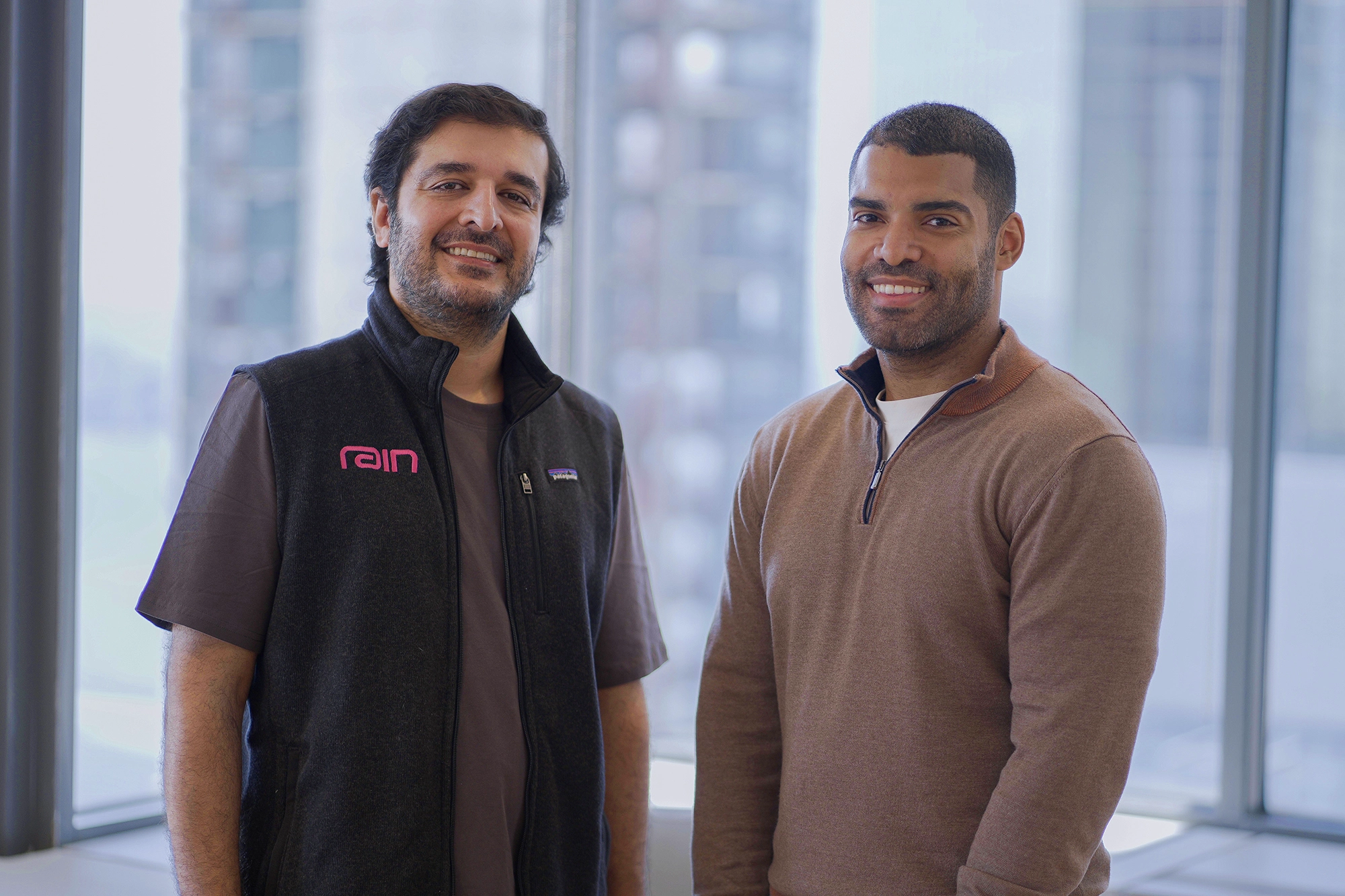
Today we announced that Rain has raised $250 million in Series C funding at a $1.95 billion valuation.
The round was led by ICONIQ, a first-time investor in Rain. Other new participants include Bessemer Venture Partners and FirstMark. We’re grateful for the continued support of our existing investors: Sapphire Ventures, Dragonfly, Galaxy Ventures, Lightspeed, Norwest, and Endeavor Catalyst.
Reaching unicorn status is a huge milestone. Don’t get us wrong, we’re thrilled to join this club, but the story here isn’t in vanity metrics. It’s in where we’re going.
How we got here
2025 was a breakout year for Rain.
We expanded our geographical footprint and platform capabilities, attracting new partners and allowing existing programs to scale.
Annualized payment volume increased by 38x and active card programs grew by 30x. Over 200 partners now trust Rain for global payments, including enterprise players like Western Union.
We made key investments in Rain’s foundation and future this year with the acquisitions of Fern and Uptop.
Fern’s multiplex, its native routing, orchestration, and compliance engine, adds to Rain’s existing infrastructure layer, improving on and offramps and multichain interoperability. Uptop, an onchain loyalty platform, brings rewards in-house, allowing us to better serve partners and deliver a core expectation to cardholders.
We also added support for more blockchains, including Stellar, Solana, and Plasma, making card programs more accessible for partners and attractive to users.
Our goals for 2026 are even more ambitious, and this latest round will support our mission to change how money moves.
Why we raised
Our Series A was about scaling our card issuance capabilities globally. We increased geographical coverage and invested in our infrastructure, including launching daily onchain settlement with Visa.
With our Series B, we expanded our suite of services. We began integrating onramps and virtual accounts, embedded wallets, advanced offramps, rewards, and more, to give enterprises a one-stop solution.
But we need to do more. That’s what our Series C is about.
We’ve never seen a fintech company that’s been able to unlock every key market across the globe for its customers. Rain’s goal is to be this company.
This round will help us get there. Expect to see better capabilities, enhanced support and hands-on partnership, more licenses to expand global operations, and products the world has never seen before.
Why now
It’s our third raise in less than 12 months. Unusual, we know.
But we also know when to read the room. We’re at a once-in-a-generation crossroads: the world is rapidly moving from traditional to onchain payment rails.
In 2025, stablecoins powered $47 trillion in transactions. Most of this was thanks to trading and cross-border B2B payments. The next wave will be stablecoin-powered consumer spending and everyday business transactions.
Tokenized money is the next era of money, and at Rain, we’re building the tools and software that will support this transition.
How do we get to mainstream adoption? Obviously, businesses need an infrastructure partner who can make stablecoin rails accessible. But appealing to the masses demands more than that. The infrastructure can’t just work, it has to be invisible.
Look at WiFi or GPS. These technologies didn’t go mainstream because people learned about data transmission or satellite trilateration; they took off because they removed friction points. When the infrastructure fades into the background, adoption follows.
That’s been Rain’s focus since day one: delivering a product that is more efficient on the backend, but seamless on the frontend.
This funding helps us get there faster. We can’t wait to deliver.
Connect with us
If you’re involved in payments at your company and these developments excite you, we’d love to work with you. Reach out to connect with our team.
If you want to help build this future, we’re hiring across the board. Explore careers at Rain here.

Unlocking global card programs for Plasma builders
In an increasingly multichain ecosystem, it’s essential for Rain to continue adapting. Our partners are building across blockchains, and we’re committed to meeting them where they are.
That’s why we’re excited to announce support for Plasma, a Layer 1 purpose-built for global payments.
With this new integration, Rain partners built on Plasma can now launch card programs that give stablecoins real-world spending power. Plasma’s zero-fee USDT transfers make it easy for users to move value instantly and at a low cost.
“Our goal is a more open financial system where stablecoins work in real life,” Paul Faecks, CEO of Plasma, said. “Adding Rain increases the card issuance options available to partners on Plasma.”
Through vertically-integrated infrastructure, Plasma’s mission is to give stablecoins real-world spending power on the payment surfaces people already rely on.
Plasma’s financial products connect traditional banking and payments with stablecoin-native rails. Working with Rain helps partners connect stablecoins on Plasma to everyday purchases.
“Rain is committed to creating financial infrastructure that is more global, open, and efficient,” Charles Yoo-Naut, CTO and Co-founder of Rain said. “A big part of that is quickly developing solutions that meet our partners’ needs.”
Rain takes the process of adding support for new chains seriously. Our protocol engineers design and implement tailor-made smart contracts, and before anything goes live, outside auditors make sure everything is running smoothly. We continue with regular audits to maintain security and trust.
Rain is the only Visa Principal Member that allows partners to launch and manage programs across multiple blockchains simultaneously, simplifying the process of issuing global cards that can be used at more than 150 million merchants.
Plasma’s integration on the Rain platform follows rising demand from partners looking to expand card access across ecosystems.

Five ways stablecoins will reshape payments in 2026
Like so many other emerging technologies, stablecoin adoption appears to be following an S-curve, characterized by three phases: slow initial adoption, a rapid acceleration period, and finally, maturation. At Rain, we believe we’re in the early days of this middle stage.
The total market capitalization for stablecoins grew by roughly $100 billion in 2025, now exceeding $300 billion for the first time in history. As the infrastructure improves, institutional adoption increases, and real-world use cases become more clear, the stablecoin market is poised for major disruption in 2026.
Here are our top predictions for the year ahead:
1. Real-world stablecoin payments will exceed trading volume
2025 saw an increase in stablecoin usage for retail spending and B2B payments, but data shows that consumer transactions still make up a relatively small portion of total stablecoin volume. That will change in 2026.
Today, stablecoins are the largest driver of onchain liquidity, but next year, we expect they will no longer be used simply to trade other crypto assets. On the enterprise side, businesses will increasingly look to stablecoins as an operational tool as opposed to just balance sheet exposure.
Legacy rails force treasury teams to hold excess buffers, pre-fund accounts, and accept delayed settlement, particularly when it comes to cross-border payments. Stablecoins offer a different model: continuous settlement rather than batch-based with real-time visibility. Treasury teams can centralize liquidity instead of fragmenting cash across multinational accounts.
In 2026, more than half of stablecoin transaction volume will originate from payments, treasury flows, and consumer spending.
2. “Chain agnostic” will become the baseline expectation
As stablecoins become the standard for payments and settlement, interoperability will be a top concern for users.
Mobile phone networks are a good parallel: in the early days of cell phones, users were locked into a single carrier, forcing them to pay high roaming fees and deal with spotty coverage. Over time, compatibility won. Today, our phones work all over the world and we don’t give it a second thought.
Stablecoins must follow a similar path in order for adoption to accelerate, and that’s why Rain acquired Fern this year. Fern’s cross-chain routing engine, known as the Multiplex, will underscore Rain’s future cross-chain bridging capabilities, improving liquidity and allowing companies to more easily move between fiat and crypto.
In 2026, the industry-wide expectation will be that stablecoins can move across chains and rails seamlessly. Platforms that lock value into one chain will face challenges scaling.
3. Stablecoin-powered consumer cards will become a standard offering
It isn’t consumer demand driving stablecoin-powered card growth, it’s brands looking for more efficient payment infrastructure. Traditional card programs are capital intensive and come with high prefunding requirements and fragmented liquidity.
Rain’s onchain solution offers faster settling and better liquidity, providing partners with a radically more capital efficient option.
Marketplaces, creator platforms, fintech apps, exchanges, and global consumer brands can all embed payments without building complex banking stacks or managing dozens of regional accounts, or without their users knowing stablecoins are involved at all.
In 2026, consumer card programs that draw on stablecoin-backed balances will become a default offering across fintechs, exchanges, creator platforms, and global apps.
4. More value will stay onchain, making off-ramps less important
As stablecoins increasingly function as global digital dollars, the need to constantly convert back to fiat currencies declines.
When payments, payrolls, remittances, and settlement can happen outside of traditional bank rails, users are less dependent on cashing out. As use cases expand and stablecoin adoption increases, offramps are less critical.
At Rain, our focus is on turning onchain value into everyday spend, allowing users and businesses to operate directly from stablecoin balances. As more value circulates within these ecosystems, off-ramps become less central to payment flows and more of a supporting function.
In 2026, stablecoin off-ramps will become less central to stablecoin-powered payment flows.
5. Agentic payments are going to turn to stablecoins
Agentic payments, transactions initiated and executed by AI agents, are already using stablecoins, and we expect this trend to continue next year.
As AI agents take on more responsibility managing business operations like supply chains and treasuries, stablecoins will be the logical choice as the settlement layer. Fiat money is embedded in systems designed around human constraints. Stablecoins provide an alternative, allowing agents to engage in financial transactions without sacrificing security.
In 2026, stablecoins will become the preferred medium of exchange for agentic payments.
If 2025 was characterized as the year stablecoins scaled, 2026 will be the year they prove their utility. Stablecoins will move from an emerging asset class to foundational financial infrastructure, and the acceleration phase is already underway.

Rebuilding global payment rails with stablecoins: Rain on Latitude Capital’s Escape Velocity podcast
Rain co-founders Farooq Malik and Charles Yoo-Naut joined Latitude Capital founder and long-time investor Ansaf Kareem on the Escape Velocity podcast to talk about why money is getting tokenized, how Rain is rebuilding payment rails from first principles, and what this shift means for companies building global products.
You can listen to and watch the full episode here.
From Rain’s early bet on stablecoin-backed cards to today’s full-stack platform for accounts, cards, and payouts, the conversation zooms out on how to make onchain dollars usable for real-world businesses at scale. Below are five key takeaways from their discussion:
1. Money is getting tokenized and every system has to catch up
Farooq puts it simply: money is moving onchain, and that means every system that moves, holds, or touches money will need to be upgraded. That includes banking cores, SWIFT terminals, and the countless internal tools enterprises use to run payouts and treasury.
For founders and enterprises, the opportunity is about both cheaper payments and always-on, programmable money.
2. Stablecoins are the primary rail, not an add-on
Rain was built stablecoin-first. Transactions post onchain 24/7, and Rain then connects that settlement layer into Visa, banks, and local payout networks.
For customers, the UX feels familiar—swiping a card, seeing an account balance, receiving a payout—while the underlying rails are global, instant, and programmable.
3. One global platform instead of a patchwork of local partners
Before Rain, “going global” meant stitching together different banks, processors, and card programs market by market, each with its own contracts, fees, and technical quirks. Many teams never tried, because the integration and maintenance burden was too high.
Rain replaces this patchwork with a single API and a single global partner. Companies can embed dollar accounts and cards for users in dozens of countries with the same look, feel, and unit economics, without rebuilding their payments stack in every market.
4. Turning payout cost centers into profit centers
One of the biggest near-term opportunities is payouts: insurance claims, creator payouts, marketplace disbursements, royalties, vendor payments, and more. Today, these flows are slow, expensive, and often treated purely as a cost of doing business.
By settling in stablecoins and issuing card- or account-based access to those funds, Rain helps companies move from “mailing checks and waiting days” to instant, programmable payouts that can actually generate margin and improve customer experience.
5. Building for the next wave of enterprise adoption
Farooq and Charles are clear that we’re still early. Regulation is moving in a more constructive direction, and stablecoin supply has already grown meaningfully.
Rain’s focus now is on being the infrastructure partner that helps those enterprises upgrade: giving them compliant, stablecoin-native rails for accounts, cards, and payouts, so they can serve a global customer base without a global rebuild.
If you’re building a neobank, wallet, exchange, payroll product, or any platform that moves money across borders, the episode is a deep dive into how Rain thinks about the future of payment rails and how stablecoins are reshaping what “global by default” can look like.

Behind the buy: strengthening Rain’s core infrastructure with Fern
Stablecoins are entering a new phase of adoption. More fiat-based companies are beginning to integrate stablecoins into their core products, and developers are expecting infrastructure that works reliably at global scale. As this shift accelerates, the requirements on the underlying technology become more demanding. Stablecoin platforms must provide reliable ways to move value between multiple fiat currencies and onchain environments, and they must support stablecoins that operate across several blockchains.
To meet these needs, Rain has acquired Fern and is welcoming their experienced team as the newest Rainmakers.
A key piece of the acquisition is Fern’s multiplex, a routing, orchestration, and compliance engine that connects diverse liquidity sources, evaluates user permissions, and determines the optimal path for converting between assets across chains. It provides a foundation that will support Rain’s future on- and off-ramp integrations and will strengthen the way stablecoins move across blockchain ecosystems.
This acquisition represents an investment in the long-term foundations of Rain’s platform. It also reflects our shared belief that stablecoins will become a primary medium for global commerce, provided the infrastructure behind them is reliable, compliant, and flexible enough to support the next generation of enterprise applications.
Why fiat connectivity matters
The first major requirement for enterprise adoption is the ability to move smoothly between fiat and stablecoins. Companies want the benefits of stablecoins, such as global reach and faster settlement, but their users and treasury operations still need fiat accounts, local payment rails, and predictable compliance flows.
Moving value from fiat into stablecoins requires a set of integrations that are consistent, safe, and adaptable across large markets. It also requires strong compliance tooling that can evaluate user permissions, track onboarding, and apply transaction-level rules.
Fern’s multiplex provides the foundational layer for this. Its architecture includes standardized interfaces, a routing engine that evaluates available liquidity, and a compliance engine that checks user permissions and transaction requirements. Together, these components form the pipes that will support Rain’s future on- and off-ramp integrations and allow us to build fiat connectivity in a more flexible and scalable way.
Why interoperability matters
As more value moves onchain, interoperability becomes equally important. Stablecoins today operate across several major networks, and enterprises increasingly need their assets to move between chains without added complexity or risk.
Interoperability is the layer that allows users and developers to treat stablecoins as a unified system rather than a collection of isolated networks. It improves liquidity, simplifies user experience, and gives developers the flexibility to incorporate the best tools available on each chain.
The multiplex helps enable this by providing a routing layer that can evaluate multiple conversion paths and select the most efficient one across different liquidity sources. This type of routing becomes essential as enterprises launch multi-chain programs and as users demand faster and more predictable movement of assets.
Strengthening interoperability is a core part of Rain’s vision for the onchain economy, and the multiplex gives us a strong foundation to build on.
Get to know the multiplex
The multiplex consists of four primary components:
- APIs: A standardized set of endpoints that connect to various liquidity providers, bank partners, and blockchains.
- Compliance Engine: A module that evaluates user permissions, onboarding status, and transaction-level requirements to ensure compliance before any action is taken.
- Liquidity Pools: A connective layer of available, permissioned liquidity providers and bank partners that the multiplex can route through for customer transactions.
- Router: A routing engine that evaluates available liquidity, compares conversion paths, and selects the optimal route for a given transaction.
This architecture gives Rain a modular system that can evolve to connect to new liquidity sources, new token standards, and new fiat partners.
The team behind Fern
Technology alone is not enough. Building and scaling infrastructure of this type requires a team with deep experience in distributed systems, cross-chain routing, security, and developer tooling.
Fern’s engineering team brings that experience to Rain. Their work at Fern demonstrates a commitment to reliability, technical rigor, and thoughtful design. The team includes senior backend and full-stack engineers who have spent years building complex systems in web3, payments, and infrastructure. Pooja Shah, who led both Filecoin and core product initiatives at Protocol Labs before founding Fern, joins Rain as Head of Product.
Their expertise will help accelerate Rain’s infrastructure roadmap and ensure that partners building on Rain benefit from stronger primitives over time.
A smooth transition for existing Fern customers
All existing services will continue without interruption for Fern customers during the integration period. Existing API keys will remain active, and the same engineering team will support customers as we collaborate on a careful transition plan to integrate Fern’s products and brand into Rain.
Customers will receive direct updates on timing, migration steps, and how the multiplex will be integrated into Rain’s platform. Our focus is on continuity and clarity as we merge the systems.
Looking ahead
Stablecoins have reached a turning point. Their global utility is becoming apparent to enterprises, developers, and users around the world. To support that growth, platforms like Rain need a strong, flexible foundation that connects fiat and onchain value and supports seamless movement across blockchain ecosystems.
The acquisition of Fern strengthens that foundation. It positions Rain to serve the next generation of stablecoin use cases with greater reliability, deeper infrastructure, and a broader vision for what money movement can become.
We are excited about what this means for the builders and partners working with Rain today. Most importantly, we are excited about what this enables in the years ahead.
If you are building a product that relies on fast, compliant, and globally capable stablecoin infrastructure, we would love to work with you.

Rain acquires Uptop to integrate rewards into its full-stack platform for enterprise card and wallet programs
Uptop—a card-linked rewards platform—is expanding beyond sports to offer rewards across retail, entertainment, travel, dining, and more.
Rain, the enterprise-grade infrastructure for stablecoin-powered payments, today announced it has acquired Uptop, an onchain rewards platform that turns everyday card purchases into loyalty for users, brands, and sponsors through simple card linking and receipt scanning.
The acquisition follows Rain’s recently secured $58 million Series B and accelerates the company’s commitment to delivering a complete, vertically integrated stack. This solution includes on-ramps, wallets, cards that work anywhere Visa is accepted, off-ramps and payouts, and now native rewards, so enterprises can launch and scale branded card and wallet programs with a single partner.
“We’re building end-to-end, stablecoin-native infrastructure so our clients don’t have to stitch it together,” said Farooq Malik, CEO & Co-founder of Rain. “By integrating rewards, Rain continues to lead the stablecoin industry as a comprehensive platform that lets partners go live and scale fast, all while keeping the consumer experience simple. With Rain and Uptop, any partner will be able to offer branded cards with built-in rewards, or launch a Starbucks-style wallet and rewards program that drives loyalty.”
Uptop is experienced in powering rewards programs for sports teams, including Cavs Rewards for the Cleveland Cavaliers, Pistons Rewards for the Detroit Pistons, and the program for LSU Athletics. In the Cavaliers program, sponsors have seen a 21% lift in spend from enrolled members and a 51% boost in Team Shop sales since launch. Beyond sports, Uptop also powers the Empire State Building’s Ambassador Program. Under Rain, Uptop will expand into additional categories including retail, entertainment, travel, dining, and more.
By bringing rewards in-house, Rain unlocks a core cardholder expectation for stablecoin-powered programs. In the near future, Rain-issued cards can be linked to the Uptop-powered rewards marketplace so cardholders earn automatically on everyday spend, and partners can sponsor bonus-earn moments to drive frequency and retention. Uptop’s onchain architecture runs on Avalanche, enabling low-latency, high-volume loyalty experiences while keeping the user experience familiar and simple.
“We built Uptop so linking a card is all it takes for people to feel closer to the brands and teams they love,” said John Timoney, Co-founder of Uptop. “As part of Rain, we can bring that simplicity to more cardholders globally, with onchain infrastructure that’s invisible to the user.”
“Our card-linked, affinity rewards have proven they drive measurable spend. The next phase is integrating at the issuing layer. Rain lets us do exactly that, at scale,” said Ross Basri, Co-founder of Uptop. “Alongside the impressive team at Rain, we can bring rewards to more partners and cardholders, faster.”
Uptop will continue to operate as an independent brand under Rain.
About Rain
Rain is the global stablecoin infrastructure platform for enterprises, neobanks, platforms, and developers. Our technology allows partners to move, store, and use stablecoins instantly and compliantly through global payment cards, on/off-ramps, wallets, and cross-border rails. As a Visa Principal Member, Rain issues cards that work anywhere Visa is accepted, powering millions of purchases in over 150 countries. Built natively for stablecoins and trusted by more than 100 organizations worldwide, Rain delivers secure, scalable infrastructure that makes money move freely and instantly around the world. Learn more at https://www.rain.xyz/.
About Uptop
Uptop, a Rain company, is an onchain rewards platform that turns everyday purchases into loyalty across categories including sports, entertainment, travel, dining, and retail. With a simple card-link or receipt-scan, Uptop lets customers earn automatically where they already shop and redeem for perks that matter. Partners and sponsors benefit from measurable outcomes like frequency, basket size, and retention. Backed by Rain, Uptop brings integrated rewards to card and wallet programs at scale. Learn more at https://www.uptop.xyz/.
Read original press release here: https://www.prnewswire.com/news-releases/rain-acquires-uptop-to-integrate-rewards-into-its-full-stack-platform-for-enterprise-card-and-wallet-programs-302611969.html

Behind the buy: making it Rain rewards
At Rain, our mission has always been clear: make onchain payments as seamless and rewarding as the best financial products in the world.
When we raised our Series B earlier this year, we committed to building a one-stop platform for enterprises to launch and scale card and payment programs, including on-ramps, wallets, universally-accepted cards, off-ramps, and payouts.
Today, we’re adding the missing piece. Rain has acquired Uptop, a rewards platform that turns everyday purchases into loyalty through simple card-linking and receipt scanning. With Uptop, Rain partners will be able to launch programs that don’t just move money — they build loyalty, drive frequency, and deepen long-term value.
Rewards are the emotional layer of payments — what makes a card worth pulling out of your wallet. And now, they’re native to Rain.
Why rewards matter more than ever
In developed card markets, rewards are expected. In the U.S., for example, nearly every card offers something back, ranging from points and perks, to cash and crypto. If you’re not offering rewards, you’re not in the game.
Rain now helps partners compete at that level from day one by enabling automatic rewards globally.
That’s a big deal. Especially as stablecoin cards expand into regions where card access is still new and rewards are almost unheard of. In these markets, Rain partners will be able to offer a level of financial empowerment that feels truly differentiated: not just global access to funds, but the ability to earn on everyday spend.
Uptop has already proven that this model works. In the Cleveland Cavaliers’ Cavs Rewards program, for example, fans who linked their cards spent 21% more with team sponsors and Team Shop sales jumped by 51%. That same technology now powers Pistons Rewards, Geaux Rewards at LSU, and the Empire State Building Ambassador Program.
When people are rewarded for their everyday behavior, they engage more. Once Uptop’s platform is fully integrated into Rain’s stack, our partners will be able to tap into that same dynamic right out of the box.
Why Uptop
From the first conversation, our teams knew the fit was obvious. Uptop had built something rare: an onchain platform that felt completely off-chain to users. Cardholders link a card once, and rewards just happen. No downloads, no checkout codes, no POS integrations. Behind the scenes, the system runs on Avalanche, handling rewards with pinpoint attribution and loyalty-scale throughput.
That blend of consumer-grade UX and enterprise-grade infrastructure mirrors how Rain was built.
This isn’t a bolt-on. Uptop is a native extension of how Rain thinks about payments. Together, we’re making it possible to design card programs that drive revenue and retention, not just transactions.
What partners will be able to do
In the coming months, Rain partners will be able to:
- Launch branded rewards without managing third-party integrations or loyalty vendors
- Build “wallet-in-a-box” programs that combine branded balances, payments, and loyalty in one clean user flow, much like Starbucks’ iconic stored-value model
- Run sponsored bonus-earn campaigns that drive measurable engagement and spend
- Access detailed data on user activation, transaction frequency, and merchant mix
This creates something powerful: a single platform for going to market fast, with compliant issuance, stablecoin infrastructure, and rewards.
Uptop will continue operating as its own brand for the foreseeable future, with its reach expanding beyond sports and entertainment into retail, travel, and dining. But the user experience will remain the same: link a card, spend where you already shop, and earn automatically.
Looking ahead
Rain has always been about unlocking the full potential of stablecoins — making them spendable, scalable, and actually useful in the real world.
This acquisition marks another leap forward in that mission. It adds depth to the Rain stack, value to every swipe, and a new layer of engagement for our partners and their customers.
For cardholders, it means loyalty that’s effortless and global. For partners, it means launching programs that work harder and scale faster.
We’re thrilled to welcome the Uptop team into the Rain family, and we can’t wait to see what you, our partners, build with rewards at your fingertips.
If you’re building a card or wallet product and want rewards to be a native part of your user experience, we’d love to talk.

How Rain keeps your smart contracts (and your reputation) safe
When you launch a card program with Rain, you're building on top of a high-performance, high-security platform. Our onchain smart contracts are what hold value, enforce the rules, and keep your program running smoothly. They’re foundational to how Rain works—highly secure, performance-tested, and built to earn trust.
We don’t just build these smart contracts. We subject them to independent security reviews, partner with best-in-class auditors like Sherlock. Sherlock is the lifecycle security partner for Web3 protocols. From development through launch to live operations, they combine AI-powered analysis, collaborative auditing, bug bounties, and financial coverage to catch vulnerabilities before they become exploits.
If you’re new to smart contracts, here’s a simple way to picture them: they’re tamper-resistant vaults with built-in instructions. They can receive, store, and send value based on clearly defined rules without any middlemen, which is why security is of the utmost importance.
We audit (and re-audit) every chain
Rain supports multiple blockchains, each with its own architecture and risk profile. That’s why we run a fresh audit every time we add support for a new chain, and continue auditing regularly to maintain security and trust.
Why? Because code doesn’t sit still. Dependencies evolve, networks upgrade, and attackers don’t take time off. Continuous assurance is the only real assurance.
Before any smart contract is available for our customers to use, we freeze the code and bring in independent auditors to review it. That includes Sherlock, one of our trusted security partners.
Sherlock doesn’t recruit auditors in a traditional sense—their network of experts grows through measured performance, not applications. Every researcher must first start by competing in open audit contests, where all submissions are tracked, judged, and scored for accuracy, false positives, and severity alignment.
Over time, this data builds a transparent performance profile for each researcher. The top performers—those consistently demonstrating precision, impact, and strong judgment—are invited into the collaborative audit pool, where they work in smaller teams led by senior auditors.
What a Rain + Sherlock audit actually looks like
Here’s how it works:
- We build the contracts. Rain’s protocol engineers design and implement smart contracts tailored to the chain in question.
- We engage independent auditors. We bring in firms, like Sherlock, and hire multiple auditors to ensure no single point of view dominates.
- They go deep. Over a week or two, these expert auditors explore the codebase, simulate threats, and look for logic errors or vulnerabilities.
- We patch and retest. Based on their findings, we fix what needs fixing, and then have the auditors confirm that the issues are resolved.
- We publish the results. Once everything’s clean, the firm issues a final report and certification. We share a plain-English summary with our customers, and provide the full report under NDA.
Critical issues (like potential fund loss or broken permissions) are rare, but if they’re found, they’re fixed fast. We also treat lower-severity findings as opportunities to improve clarity, efficiency, and maintainability.
We also regularly schedule additional audits when new features are launched or environments change, and our smart contract infrastructure gets thoroughly vetted for every new blockchain we deploy to. Where a bug bounty is appropriate, we work with Sherlock to define scope, rewards, and a responsible disclosure path.
Want proof? Let’s talk.
If you're evaluating a specific chain or use case, we can share the relevant certifications, audit histories, and a summary packet that walks through our approach. We’re also happy to connect you with an Engineering lead to answer questions or walk you through how upgrades and ongoing monitoring work.
At Rain, we sweat the hard stuff so your program can launch fast, scale cleanly, and operate with confidence.

Behind dollar cards: How Rain and Visa are rebuilding global payment settlement
Rain CEO and co-founder Farooq Malik joined Visa’s Head of Crypto, Cuy Sheffield, on StableMinded to talk shop about how stablecoins are transforming payments infrastructure and what that means for enterprises, fintechs, and global economies.
You can listen to the full episode here.
From Rain’s early bet on stablecoin-backed corporate cards to Visa’s bold move toward blockchain-based settlement, the conversation explored how these two companies are teaming up to modernize money movement on a global scale. Below are the top five takeaways from their conversation:
1. Stablecoins are quietly changing the game
While crypto headlines come and go, stablecoins are quietly doing the real work—enabling faster, more reliable financial flows across borders. For Rain’s customers, stablecoins are operational currency used for payroll, cloud services, and day-to-day purchases.
The world needs payment rails that operate at internet speed. And that’s exactly what Rain is building.
2. Rain + Visa = 24/7 settlement infrastructure
Rain became the first issuer to settle Visa transactions using stablecoins every day of the week. This unlocks near-instant liquidity, reduces working capital constraints, and eliminates legacy bottlenecks like wire cutoffs and bank holidays.
Cuy from Visa describes this as an evolution from a two-dimensional treasury system to a four-dimensional model, where the key variables include currency, format (fiat or stablecoin), delivery method (Fedwire or blockchain), and the blockchain network itself. Rain’s infrastructure makes this complexity invisible to the user while powering faster, always-on settlement.
3. Built stablecoin-first, with Visa at the core
Rain didn’t retrofit stablecoins into a legacy system—it was built from the ground up as a stablecoin-native platform. Every Rain customer settles in stablecoins, and Rain itself settles with Visa the same way.
This deep integration is what makes the Rain—Visa model unique. Rain can adapt quickly to support new tokens and chains while aligning with Visa’s rigorous requirements for security, scale, and compliance. The result is a globally connected payments stack that works out of the box for new markets and use cases.
4. Turning “dollar cards” into daily spend
Thanks to this partnership, stablecoin-powered cards are becoming everyday financial tools, especially in emerging markets. Users call them “dollar cards” and use them for everything from groceries to business expenses, with no need to understand the tech behind it.
Rain is also partnered with merchant acquirers, like Nuvei, to support merchant payouts in stablecoins across LATAM. These merchants receive a Rain-powered wallet with a built-in Visa card, so they can spend against those stablecoin balances instantly, without ever having to off-ramp to fiat. This means money flows from consumer to merchant and back again, all within the Visa network and powered by stablecoin settlement.
5. Expanding access to the modern financial stack
Visa’s priority now is scaling this model across more markets. Rain’s role is to make that expansion possible through flexible APIs, onchain infrastructure, and compliance-ready solutions.
This collaboration is a clear example of how legacy payment leaders and next-gen platforms can come together to redefine what’s possible. For users, that means faster payments, broader access, and fewer fees. For enterprises, neobanks, platforms, and developers, it means global reach without global rebuilds.