How to launch global card programs without starting over in every market
Scaling your product should get easier over time, not harder. But for most teams, expanding a card program internationally requires starting from square one in every new market.
Moving into a new country means finding a new issuer, adapting to new regulations, and dealing with one lengthy timeline after another. Progress slows just when momentum matters most.
Rain breaks that pattern. We’ve built the licensing, compliance, and stablecoin infrastructure so you don’t have to start from scratch in every new region. With a single integration, you can issue cards globally through a platform designed to work across borders and help your business scale.
The traditional model wasn’t made for global expansion
When it comes to issuing cards in a single market, the process is well understood, but far from easy. Teams still need to secure a BIN sponsor, integrate a processor, set up KYC and compliance workflows, and coordinate across multiple partners before going live.
After all that, when it’s time to expand, companies can’t just “copy and paste.” Teams that want to go global have to:
- Partner with a new issuer in every country or region
- Rebuild compliance flows
- Reintegrate wallets, KYC systems, and settlement rails
- Absorb longer timelines, higher costs, and greater regulatory risk
The result is a fragmented setup that’s expensive to maintain and difficult to replicate.
A platform that removes the roadblocks
Rain is designed to support expansion without fragmentation. With us, the process doesn’t have to restart with every new country.
For neobank KAST, partnering with Rain was about taking their existing card program global. The team wanted to expand into new countries, but redesigning their stack for each individual launch was impractical. With Rain, KAST was able to bring their program into new regions quickly, maintain consistency for users, and scout the operational overhead that typically slows international rollouts.
For companies launching a new program from the ground up, Rain’s approach is the same: deliver a full-stack that comes with one platform, one integration, and is designed to scale when you’re ready.
Stablecoins for settlement, fiat for users
Rain has secured the approvals needed to issue cards in dozens of countries. As a Visa Principal Member, we can issue directly and enable card programs that work at over 150 million merchant locations in more than 150 countries.
For users, that means a card that works exactly how they expect it would. Cardholders don’t need to hold crypto, and they won’t know stablecoins are powering everything on the back end.
Behind the scenes, Rain settles with Visa every single day – including weekends and holidays – using stablecoins. For Rain partners, that means reduced working capital and reserve requirements, while still allowing programs to be funded in fiat via wire, ACH, or SWIFT transfers.
Virtual and physical cards, out of the box
Rain supports both virtual and physical cards through the same API. Virtual cards can be added to Apple Pay and Google Wallet, making them ideal for immediate access or remote users. Physical cards are available in supported regions and fully customizable.
Whether you’re issuing spend cards for individual users or rolling out a corporate card program for a globally distributed workforce, Rain helps you deploy fast.
Built-in compliance and KYC
Every Rain-issued card program includes required KYC and AML workflows. We cover onboarding, identity verification, ongoing monitoring, and country-specific requirements, so you can stay compliant without having to build your own risk and ops stack.
Flexible by design
Rain is modular. You can use the full platform or integrate only what you need alongside your existing systems. That makes it possible to:
- Add cards to existing user wallets
- Maintain control over branding, issuance logic, and customer service
- Expand into new markets without disrupting what’s already live
And as your needs evolve, you can introduce features like spend controls, rewards, or multi-currency support without reworking your core infrastructure.
Launch faster. Scale smarter.
We’ve seen teams spend years and significant capital building global card programs the hard way. Rain’s goal is to provide a better system.
With Rain, you can:
- Launch in new regions without sourcing a new issuer each time
- Simplify settlement and reduce capital overhead
- Issue cards immediately usable for real-world spending
- Customize and grow your program without losing visibility or control
Whether you’re a fintech expanding internationally or a Web3 platform making digital assets spendable, Rain provides the foundation to grow across markets.
The bottom line
Global expansion doesn’t have to mean starting over. With Rain, the infrastructure is already in place. The rails are ready. And your cards are good to go.
If you’re ready to scale without the slowdowns, let’s talk.

How Rain’s authorization rate is one of the highest across stablecoin cards
Authorization rate is a direct measure of how well a card program’s infrastructure performs in the real world.
A high authorization rate means things like fraud checks, balance logic, and merchant codes are working as intended. A low authorization rate signals issues, like misaligned risk models, poor network compliance, or technical malfunctions.
Multiple parties are involved in approving or declining a transaction, but for the card issuer in particular, maintaining a high authorization rate is a significant lift. Fraud detection and network compliance are two of the biggest drivers of authorization rate, and both are Rain’s responsibility.
Over the past twelve months, Rain has consistently reported an authorization rate of 95% to 97%, excluding expected declines. This means when a cardholder makes an intended purchase with a Rain-issued card, it goes through nearly every time. The global average authorization rate is between 85% and 95%.
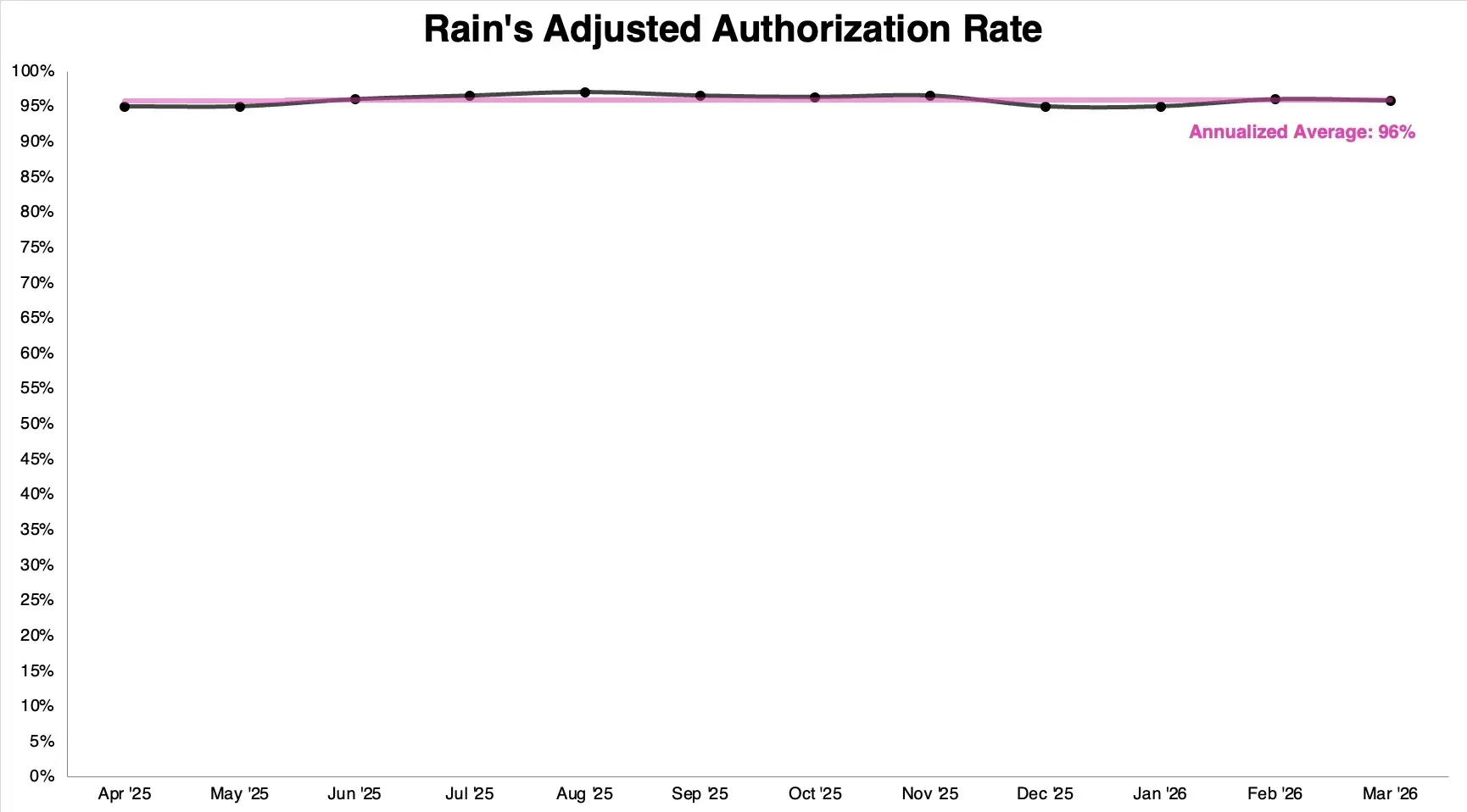
Rain’s authorization rate is the result of deliberate choices about infrastructure and risk management, choices we think every cardholder and partner should understand. Let’s explore:
Rain’s design means most declines are expected
Rain is a collateral-backed credit card, meaning every transaction is backed by secured assets. If a purchase amount exceeds the available deposits, the transaction is declined. As such, the vast majority of declines on Rain-issued cards are the result of insufficient funds. These are not systemic failures, but expected, mechanical outcomes that result from how the product works.
Partners have visibility into decline reasons through Rain's reporting, so if a transaction is blocked for this reason, they can alert cardholders. Partners can also build in notification tools that flag when a cardholder’s deposits dip below a certain threshold. These include push notifications, emails, or SMS to prompt cardholders to top up their balance.
Rain’s fraud detection is effective
A high authorization rate is typically indicative of a well-designed, functional fraud detection system. Overly aggressive fraud controls are not a sign that a program is safer, but an indication that the risk models lack sophistication.
A program that blocks liberally will inevitably block some fraud, but it will also block a significant volume of legitimate transactions. The fraud reduction is a byproduct of suppression rather than detection.
At Rain, the goal is not maximum blocking, it’s precision, and getting there starts early. A significant reason why Rain’s fraud detection program is so effective is that the due diligence process is extensive. Before a program goes live, Rain completes a thorough review of the partner's business model and risk profile.
At the cardholder level, Rain employs Customer Identification Program (CIP) standards that go beyond the regulatory minimum, collecting not just identity documents but information like occupation, annual income, and IP address. This additional context helps establish a baseline for what normal activity looks like for each cardholder, so genuinely unusual behavior stands out and declines are informed by real data, not indiscriminately issued. The result is a program that doesn't treat caution and performance as competing priorities.
The bottom line
Partners don't build card programs for the infrastructure, they build them for growth. More cardholders means more spend, which means more revenue. Authorization rate is one of the most direct levers for all three.
At 95–97%, Rain's programs are performing at the top of the market. Every percentage point above average is more transactions completed, more cardholders who keep using the card, and more revenue flowing to partners.
Rain's authorization rate didn't happen by accident, and it isn’t sustained without ongoing work. If you want to learn more about how Rain approaches card issuance or explore what a partnership looks like, let’s talk.

How Rain powers Wallbit's card program for remote workers in Latin America
Remote work is reshaping economies globally, especially in Latin America (LATAM) where thousands of remote workers receive salaries in USD. Despite earning in a stable global currency, these workers often face substantial hurdles in accessing, managing, and spending their USD earnings conveniently. Traditional banking solutions often result in costly currency conversions, restrictive access, and complicated withdrawal processes, impacting financial freedom and efficiency. Wallbit, a US-based digital neobank servicing LATAM remote workers, recognized the pressing need to provide their users with a robust, frictionless, and globally accepted payment solution.
The solution
To address these challenges, Wallbit partnered with Rain to launch their Visa card program. Leveraging Rain's advanced card issuance infrastructure, Wallbit is now able to offer its users commission-free USD credit cards that simplify the process of spending and managing earnings worldwide. Key elements of Rain's solution include:
- Global spending freedom: Wallbit users receive Visa credit cards issued in the US, enabling effortless payments both locally and internationally, free from costly conversions or complicated fees.
- Simplified financial management: Remote workers can seamlessly access and utilize their USD income directly, whether paying for local expenses, traveling abroad, or subscribing to online services, all without additional taxes or charges.
- Robust security and reliability: Rain’s secure card issuance infrastructure includes advanced security measures and real-time fraud monitoring, protecting user funds and data.
- Scalable infrastructure: Rain's flexible and reliable system enables Wallbit to rapidly scale their card program, accommodating growing demand across their key markets in Argentina, Colombia, and Mexico.
The results
The collaboration between Rain and Wallbit has significantly improved financial access and usability for remote workers across LATAM:
- Empowering financial inclusion: Thousands of remote workers across Argentina, Colombia, and Mexico now enjoy unrestricted access to their USD income, eliminating previous financial barriers and creating greater financial independence.
- Reduced transaction costs: By eliminating unnecessary currency conversions and fees, users see immediate savings, improving their overall financial wellbeing.
- Enhanced user satisfaction: Wallbit has reported high customer satisfaction rates, with users valuing the ease and convenience of managing their finances through the Wallbit app and Rain-enabled Visa Platinum card.
- Increased adoption and usage: The streamlined and globally accepted credit card has driven growth in new user adoption and existing customer engagement for Wallbit, solidifying its position as a leading digital banking solution for remote workers in the region.
“Partnering with Rain has enabled Wallbit to truly unlock financial freedom for our users. Remote workers in LATAM now have seamless access to their USD earnings, without unnecessary fees or friction.” — Rodrigo Vidal, CEO of Wallbit
Conclusion
Through Rain’s innovative card issuance technology, Wallbit is successfully addressing the unique financial needs of LATAM's remote workforce. By seamlessly integrating USD-based spending and management into everyday life, Wallbit and Rain together provide remote workers freedom and flexibility, ushering in a new era where the future of work meets the future of banking.

How Rain powers Cadana’s card program for a globally distributed workforce
In emerging markets, millions of workers and businesses lack access to traditional banking infrastructure, limiting their ability to transact globally. Remote workers, freelancers, and businesses operating across borders often face challenges with payment reliability, high transaction fees, and limited access to USD-based financial tools.
Cadana, a fintech focused on financial inclusion for workers in emerging markets, sought a solution that would provide its users with secure, flexible, and globally accepted payment options. They needed a partner that could enable seamless virtual card issuance while ensuring transaction reliability and security across emerging markets.
The solution
Rain partnered with Cadana to power its virtual card program, providing users in emerging markets with a secure and efficient way to receive payments, transact online, and participate in the global economy. By leveraging Rain’s digital infrastructure, Cadana’s virtual card offering delivers:
- Seamless cross-border transactions: Rain’s technology ensures Cadana users can access globally accepted virtual USD cards, enabling payments across international platforms without friction.
- Enhanced security & fraud protection: With dynamic card details, real-time monitoring, and strict security protocols, Rain’s infrastructure minimizes fraud risks while protecting user data.
- Financial access for the underbanked: Rain’s virtual card capabilities help bridge the gap for workers and businesses without traditional bank accounts, providing them with a digital-first financial solution that works anywhere.
- Scalability & reliability: Rain’s partnership ensures Cadana can issue and manage virtual cards at scale, providing a stable and high-availability solution that meets the needs of a globally distributed workforce.
The results
With Rain’s card infrastructure, Cadana has expanded financial access for workers and businesses across emerging markets. Key outcomes include:
- Empowering financial inclusion: Thousands of users now have reliable access to virtual USD cards, eliminating barriers to global commerce and financial participation.
- Improved payment efficiency: Rain’s technology enables faster and more reliable payments for remote workers and businesses, reducing delays and transaction costs.
- Enhanced security & compliance: The partnership ensures that Cadana’s virtual card program meets the highest security standards, protecting users while maintaining compliance with financial regulations.
Conclusion
Rain’s cutting-edge card infrastructure plays a crucial role in enabling Cadana’s mission to provide financial access to workers in emerging markets. By simplifying cross-border payments and ensuring secure transactions, Rain helps drive financial inclusion and economic growth in underserved regions.