Introducing real-time funding
.webp)
Stablecoin cards have traditionally required users to manage two balances: the one in their wallet and the one powering their card’s spending limit.
Before making a purchase, users have had to allocate stablecoins to a separate collateral contract. When that balance runs low, they have to replenish it.
Real-time funding removes that loop.
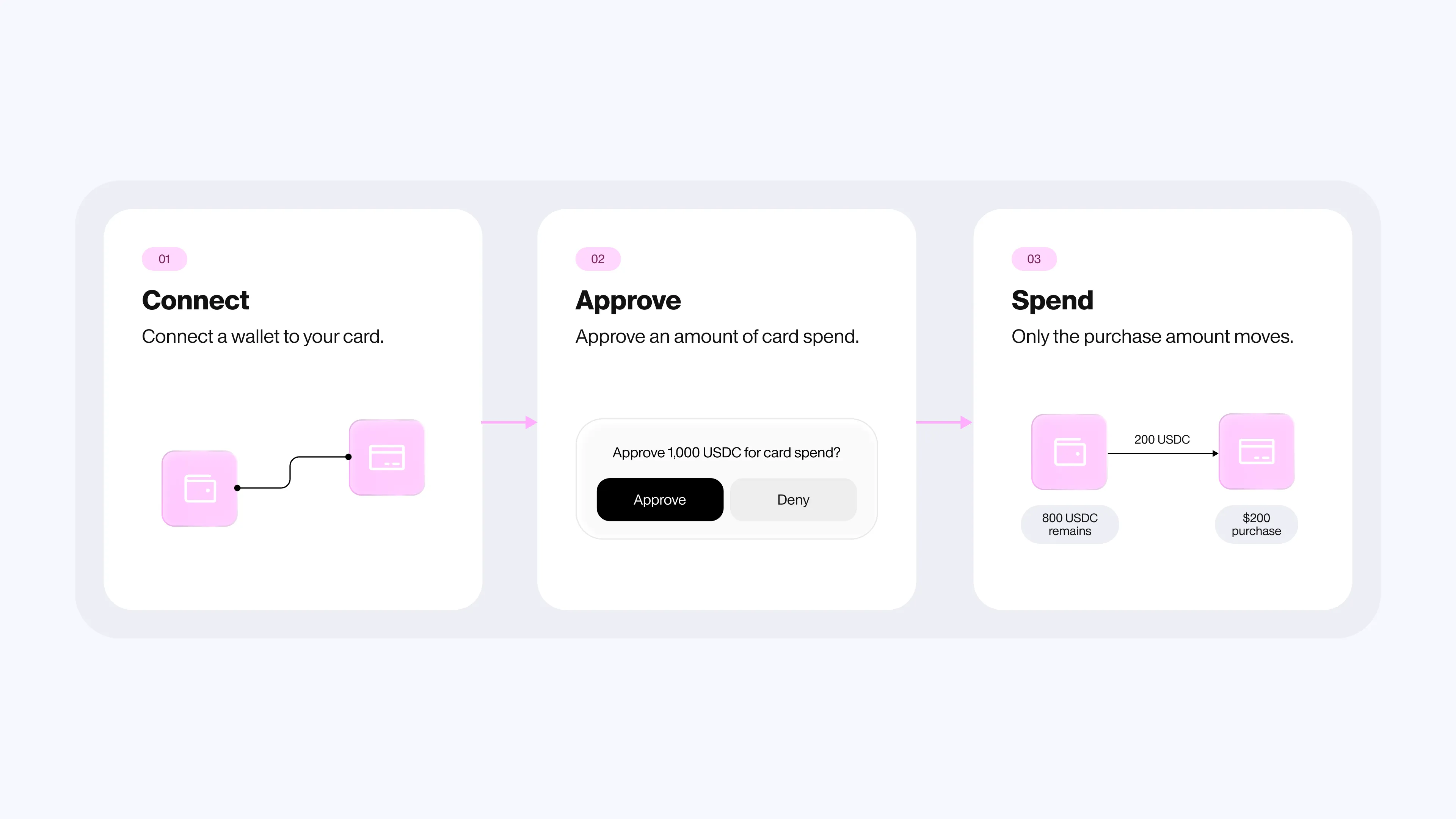
With real-time funding, users connect a wallet and approve how much their card can spend. From there, each purchase is authorized against the wallet balance in real time. Only the amount needed is committed to the collateral contract at authorization, where it stays until settlement. The rest stays in the user's wallet. The approval is revocable at any time.
One balance to manage
Until now, a stablecoin cardholder could have plenty of funds in their wallet and still need to maintain a separate balance behind their card.
Real-time funding changes that.
Instead of allocating stablecoins into a collateral contract before spending, the user keeps their funds in their wallet until they are needed for a transaction. Authorization handles the rest, removing the need for users to monitor and repeatedly replenish a separate balance.
For card programs, that creates a simpler experience at both ends of the user journey.
New cardholders no longer need to complete a separate step before making their first purchase. Existing cardholders no longer need to remember to replenish a separate balance to increase spending power.
Connect a wallet. Approve once. Spend.
How real-time funding works
The user first connects a supported wallet and approves how much their card can spend.
When they make a purchase, only the amount needed for that transaction is committed to the collateral contract during authorization, where it remains until it is liquidated to repay Rain’s extension of credit to the user. The remaining balance stays in the wallet.
For example, imagine a user has 1,000 USDC in their wallet and has approved that full balance for card spend.
They make a $200 purchase.
At authorization, 200 USDC is committed to back the transaction. The remaining 800 USDC stays in the user's wallet.
The underlying collateral model does not change. Each user still has their own collateral contract backing authorized card transactions. Real-time funding changes when that contract is funded, shifting the funding trigger into the authorization flow instead of requiring the user to fund it in advance.
Built for smoother card activation
The initial setup is one of the places new cardholders can stall.
They have to allocate stablecoins to a contract, wait for confirmation, and understand why a separate balance is necessary before they can use their card. Real-time funding removes that step from the path to a first transaction.
After activation, the experience stays simpler because there is no separate balance for the user to keep monitoring and replenishing.
For partners, that means fewer steps to put in front of users and a more intuitive path from wallet to spend.
Available in beta
Real-time funding is currently in beta for card programs where Rain manages authorization infrastructure.
At launch, supported assets and networks include:
- USDC on Base
- USDC on Arbitrum
- USDT0 on Plasma
More chains and assets will follow.
General availability is coming soon.
To learn more about real-time funding or discuss enabling it for your card program, visit the Rain documentation or contact your Rain account team.


.webp)