Western Union’s Stablecard goes live on Rain

Western Union is a 175-year-old remittance giant and one of the most trusted brands in the world.
Each year it moves $100B+ across 200+ countries and territories, through hundreds of thousands of physical locations, to more than 100 million customers.
Today, Western Union is rolling out Stablecard, which rethinks how remittances work, powered by Rain's full suite of stablecoin infrastructure. Remittances can now land as USDPT in the Stablecard mobile app and be spent instantly anywhere Visa is accepted with an integrated card. USDPT™ is Western Union's own stablecoin issued by Anchorage Digital Bank on Solana.
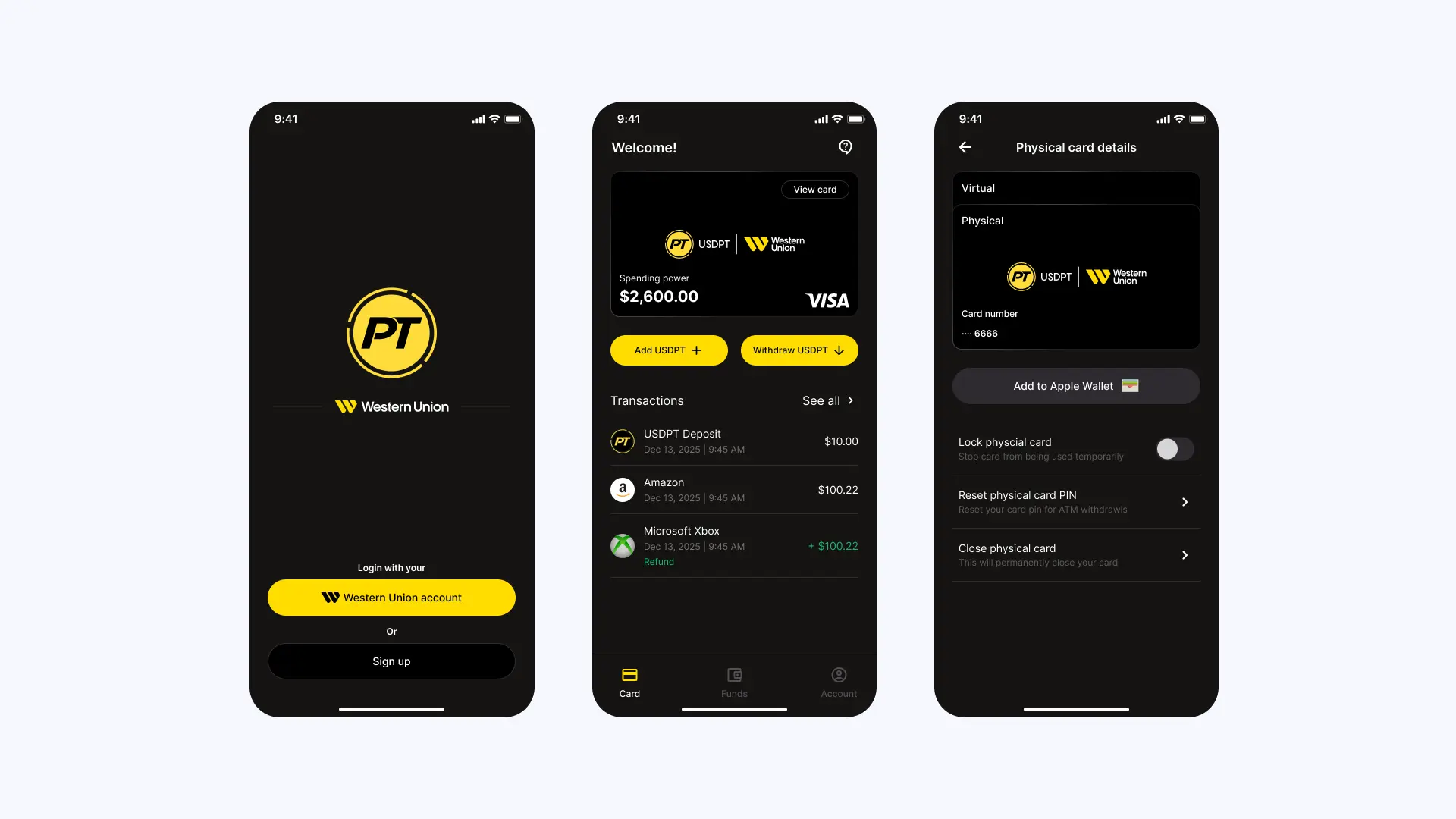
Stablecard is a key part of a much larger transformation that will let Western Union become more capital efficient, offer new services, and serve more customers than it could before. The app is now live on Google Play and the App Store.
Physical cash is now optional
For most of its 175 years, receiving a Western Union transfer meant walking into a physical location, showing your ID and transfer number, and walking out with cash in local currency.
Money now arrives digitally. Remittances can land as USDPT, funding a Stablecard issued instantly and enabled on Apple Pay or Google Pay. Recipients can still convert to a cash withdrawal at any Western Union location, but they can also hold their funds as US dollar stablecoins in the app and spend them at more than 175 million merchant locations worldwide, online or in store. For many recipients, this offers their first access to digitally native financial services.
For Western Union, the shift means more services for more users. Historically, a recipient exited the ecosystem the moment they picked up cash. Now the relationship continues after the money arrives, and Western Union can layer on new digital products and services over time, such as onchain loyalty programs.
Unlocking capital efficiency
Letting customers receive and spend stablecoins also makes Western Union a more capital-efficient business.
Traditional cross-border remittances run on prefunding. Western Union funds bank accounts throughout the world that its locations draw from to pay out cash. And because the correspondent banking system runs nine-to-five and not on weekends or holidays, that money has to be in place days before it's needed. This means forecasting demand and parking capital all over the world, where it sits idle until a customer needs it.
Stablecoins attack that cost from both ends. Every dollar that stays in the app never needs to be prefunded or held idle in a bank account. And when someone does want cash, USDPT settles in seconds, any hour of any day, so Western Union can move money the moment it's needed rather than days in advance. Capital can follow demand instead of a forecast.
What was funds in, funds out becomes money held in the app and spent inside the ecosystem, while capital that once sat idle is freed up for better use elsewhere for Western Union's business.
Reaching more customers
Stablecard is going live in 37 markets, with Western Union targeting 60+ by the end of the year. Many where demand for stablecoins is already visible.
Over time, Stablecard also points to customers Western Union has never served: people with no remittance to receive who simply want to hold and spend dollars with a brand they already trust.
"Stablecard represents the next step in making global financial services more accessible to our customers," said Devin McGranahan, President and Chief Executive Officer of Western Union.
Expansion used to be the hard part. A traditional card program takes three to six months of work per market: local issuing partners, regional teams, real operational lift. That math caps how many markets are worth entering at all.
Rain's infrastructure removes the cap. A single integration, with licensing and issuing already in place, lets Western Union launch markets all at once rather than region by region. And when trying a new market costs marketing spend instead of months of operational overhead, Western Union can afford to test markets it may have never touched before.
Why Western Union chose Rain
Western Union needed more than a card issuer. It needed an all-in-one partner that could deliver the end-to-end experience: the mobile app itself, embedded wallet infrastructure that supports USDPT, and the integrated Visa card, all tailored to how Western Union serves its customers.
And a 175-year-old public company has an exceedingly high bar. Rain was selected through a formal process, judged against the same standard Western Union holds itself to as one of the most regulated remittance companies in the world.
"The technology stack is pretty repeatable. That's not always the moat. What carries the highest weight is durability, operational support, and the ability to meet our compliance requirements," said Malcolm Clarke, Global Head of Digital Assets at Western Union.
Rain cleared that bar: a Visa Principal Member whose cards already work in over 200 countries and territories, with licensing, issuing, and compliance built for global institutions from day one rather than retrofitted for them.
"Rain was built for exactly this: enterprise-grade rails with compliance and consumer protections in from the start," said Farooq Malik, CEO and Co-founder of Rain.
Stablecard is rolling out now, with more markets in the months ahead. Enterprises exploring stablecoin-powered cards and wallets can learn more at rain.xyz.